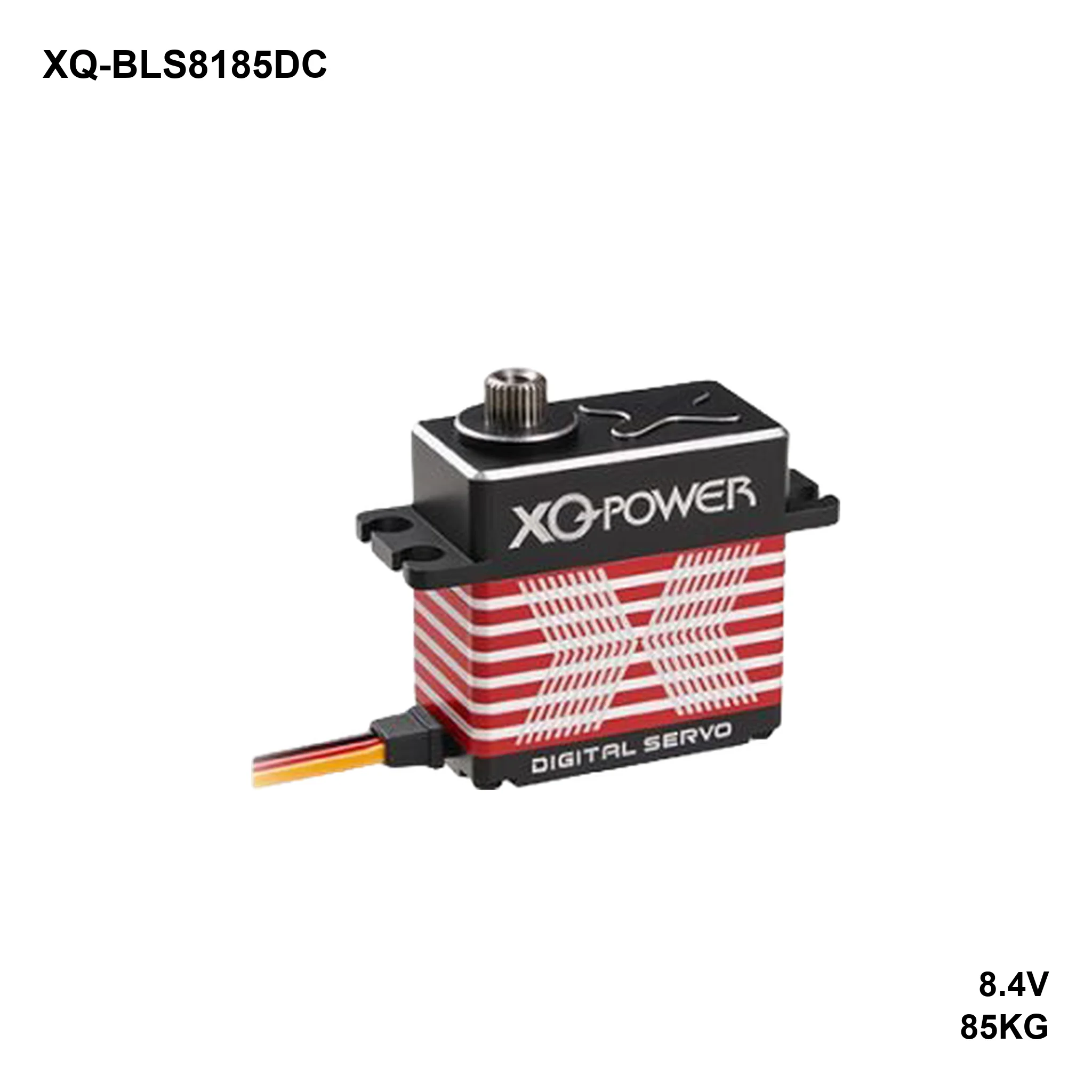
| 85KG·CM STALL | 0.110S/60° NO-LOAD | 8.4V RATED |
| 92G WEIGHT | StainlessGEARTRAIN | 360°TRAVELCustomizable |
Overview
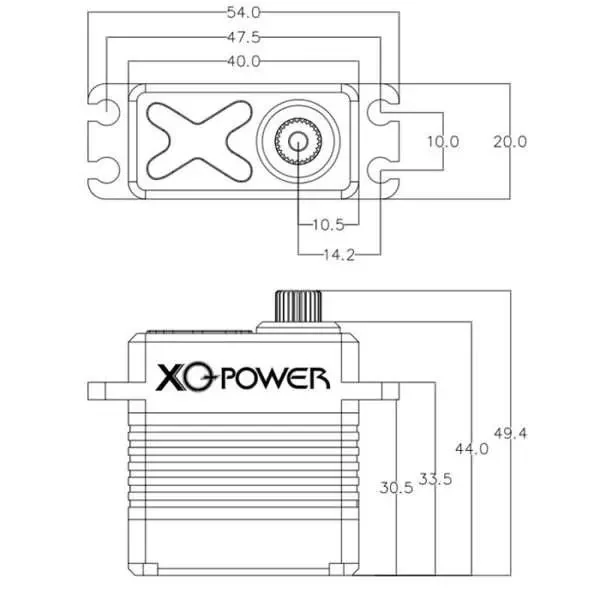
The BLS8185D is the 85 kg·cm low-voltage build: 20 × 40 × 44 mm, 92 g, and the same 25T-φ7.96 mm output as the 8175D one step down. It reaches its full 85 kg·cm at 8.4 V, which is what makes it a 2S part rather than a 4S one.
Stainless steel geartrain on two ball bearings, CNC aluminium case, and a 7075 aluminium CNC horn in the box — at this torque a POM horn is not the right default. The output has no mechanical stop, so travel is set entirely by the controller, and the 360° running degree is a real option rather than a customization that needs a different part.
This page covers the CAN build: the same mechanics on a CAN bus, with arbitration and error checking handled in hardware. The version to pick when the machine already speaks CAN and a dropped frame must not become a wrong angle.
Performance at each supply voltage
| Supply | No-load speed | Peak stall torque | Idle current | Stall current |
|---|---|---|---|---|
| 6.0 V | 0.170 s/60° (353 °/s) | 42 kg·cm (4.12 N·m / 583 oz·in) | 320 mA | 4.0 A |
| 7.4 V | 0.140 s/60° (429 °/s) | 75 kg·cm (7.36 N·m / 1042 oz·in) | 370 mA | 5.0 A |
| 8.4 V | 0.110 s/60° (545 °/s) | 85 kg·cm (8.34 N·m / 1180 oz·in) | 440 mA | 6.0 A |
Control specification
| Item | Specification |
|---|---|
| Command signal | CAN bus |
| Amplifier | Digital controller |
| Dead band | 2 µs |
| Rotating direction | CCW (1000–2000 µs) |
| Travel | 360°, customizable |
Mechanical specification
| Item | Specification | Item | Specification |
|---|---|---|---|
| Dimensions | 20 × 40 × 44 mm | Case material | Aluminium, CNC |
| Weight | 92 g | Geartrain | Stainless steel |
| Bearings | 2 × ball bearing | Motor | Brushless |
| Output spline | 25T-φ7.96 mm | Horn | 7075 aluminium, CNC |
| Lead / connector | 300 mm, 3-wire | Mechanical limit | No limit |
| Operating temperature | −15 °C to 65 °C | Storage temperature | −20 °C to 70 °C |
| Ingress protection | Splash resistant (customizable) | Travel | 360°, customizable |
What’s in the box
- 1 × XQ-BLS8185DC servo
- 1 × 7075 aluminium horn
- 1 × mounting screw pack
How to size it
Torque is 42 kg·cm at 6.0 V, 75 at 7.4 V and 85 at 8.4 V, at 0.17, 0.14 and 0.11 s/60°. The step from 6.0 V to 7.4 V is unusually large on this winding — on a 2S pack that sits near 7.4 V under load, the honest working figure is 75, not 85.
Stall current runs 4.0 A at 6.0 V, 5.0 A at 7.4 V and 6.0 A at 8.4 V. Two of these on one rail is 12 A at stall. If the receiver resets during a hard manoeuvre, add a servo rail before changing the servo.
FAQ
BLS8185D or BLS8185HV?
Same case, same geartrain, same 92 g — different winding. The low-voltage build gives 85 kg·cm at 8.4 V and is meant for 2S. The HV build gives the same 85 kg·cm at 16.8 V and only 42 kg·cm at 8.4 V. Pick by the pack you already run, not by the headline torque.
Will my 25T horns fit?
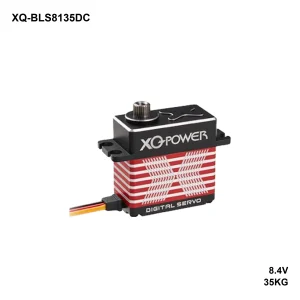
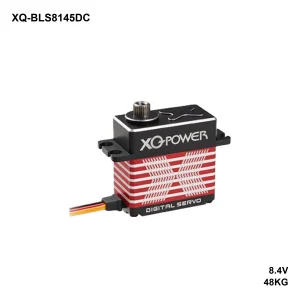
Check the centre diameter — this is a φ7.96 mm spline, the same as the 8175D, not the φ5.94 mm used on the 8135D and 8145D. A φ5.94 horn will not seat, even though both are called 25T.
What bitrate and message set does it use?
Not printed on the inspection sheet. Ask for the CAN message set, bitrate options and node ID range before integration; they are supplied on request.
Why CAN instead of RS-485?
Arbitration and error detection are in hardware, so a corrupted frame is discarded rather than acted on, and several nodes can share the bus without a master polling loop.
Other interfaces
Downloads
- XQ-BLS8185DC inspection specification (PDF, 807 KB)
Torque, speed and current at each supply voltage, mechanical data, control specification, mounting dimensions. - 2D dimension drawing (image)
Mounting hole positions, case depth and overall height; the same drawing is inside the datasheet.