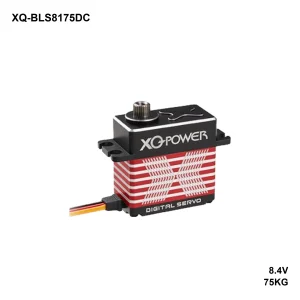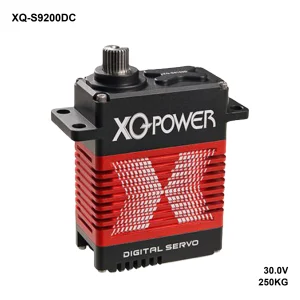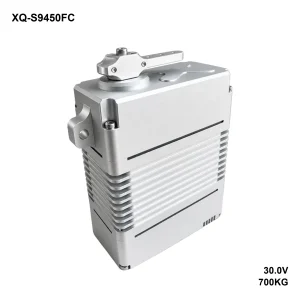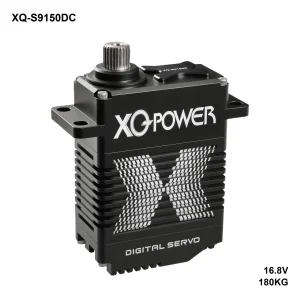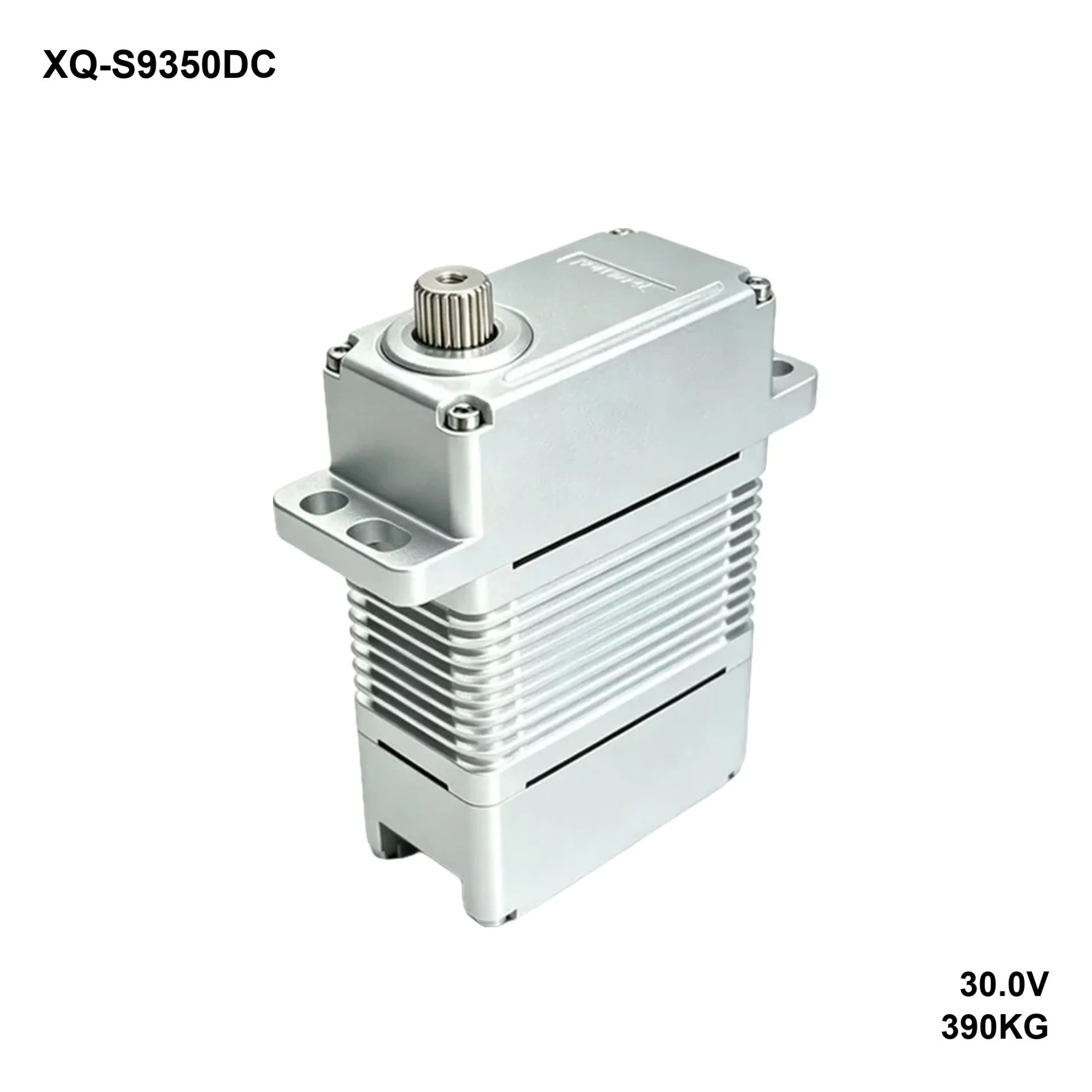
| 390KG·CM STALL | 0.160S/60° NO-LOAD | 30V RATED |
| 690G WEIGHT | SteelGEARTRAIN | 360°TRAVELCustomizable |
Overview
The 9350 is the heaviest servo in the range: 390 kg·cm at 30 V, 690 g, in a 68 × 35 × 120 mm body machined from 7075 aluminium. Everything structural is 7075 including the output horn, which is a step up from the 6061-class cases used lower in the range.
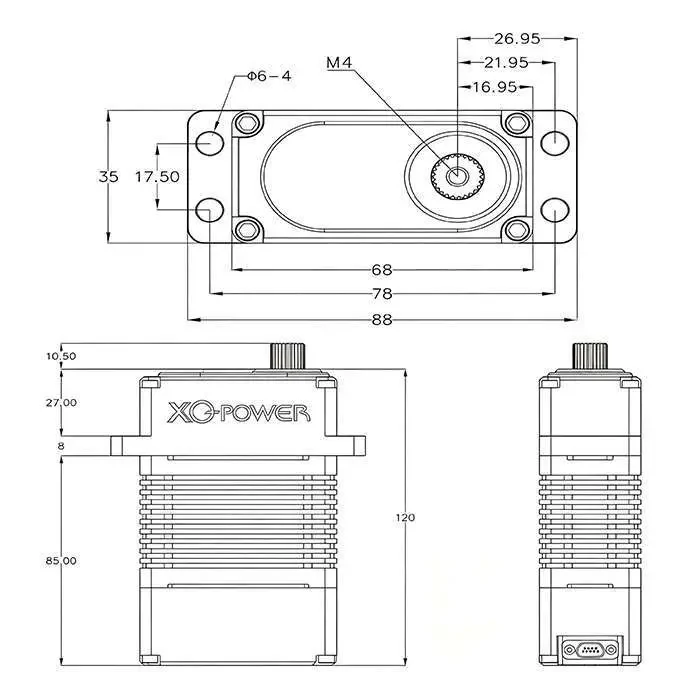
Six ball bearings support a steel geartrain on a 25T-φ11.8 mm spline. The case has four M6 through-holes on a 68 mm spacing and a 8 mm thick mounting flange — the drawing in Downloads gives the full pattern, because this is a part you design a bracket around, not a part you bolt to a standard tray.
This page covers the CAN build: the same mechanics on a CAN bus, with arbitration and error checking handled in hardware. The version to pick when the machine already speaks CAN and a dropped frame must not become a wrong angle.
Performance at each supply voltage
| Supply | No-load speed | Peak stall torque | Idle current | Stall current |
|---|---|---|---|---|
| 24 V | 0.280 s/60° (214 °/s) | 320 kg·cm (31.39 N·m / 4444 oz·in) | 200 mA | 5 A |
| 28 V | 0.200 s/60° (300 °/s) | 360 kg·cm (35.32 N·m / 4999 oz·in) | 300 mA | 6.5 A |
| 30 V | 0.160 s/60° (375 °/s) | 390 kg·cm (38.26 N·m / 5416 oz·in) | 400 mA | 7 A |
Control specification
| Item | Specification |
|---|---|
| Command signal | CAN bus |
| Amplifier | Digital controller |
| Dead band | 3 µs |
| Rotating direction | CCW (1000–2000 µs), customizable |
| Travel | 360°, customizable |
Mechanical specification
| Item | Specification | Item | Specification |
|---|---|---|---|
| Dimensions | 68 × 35 × 120 mm | Case material | 7075 aluminium, CNC |
| Weight | 690 g | Geartrain | Steel |
| Bearings | 6 × ball bearing | Motor | Brushless |
| Output spline | 25T-φ11.8 mm | Horn | 7075 aluminium, CNC |
| Lead / connector | Socket, cable sold separately | Mechanical limit | No limit |
| Operating temperature | −30 °C to 65 °C | Storage temperature | −30 °C to 70 °C |
| Ingress protection | Splash resistant (customizable) | Travel | 360°, customizable |
What’s in the box
- 1 × XQ-S9350DC servo
- 1 × 7075 aluminium horn
- 1 × mounting screw pack
How to size it
At 390 kg·cm the reaction torque on the mounting bracket is the real design constraint. Four M6 bolts on a 68 mm spacing carry it, but the bracket has to be stiff — a flexing plate will show up as lost travel at the output, not as a servo fault.
The 390 kg·cm figure needs 30 V. On 24 V it is 320 kg·cm at 0.28 s/60°, and stall current is only 5 A. If your supply sags under load, size the linkage at the sagged voltage, not at the label.
FAQ
What is the difference between the 9200 and the 9350?
Torque and size: the 9350 is 390 kg·cm in a 68 × 35 × 120 mm, 690 g 7075 case; the 9200 is 250 kg·cm in a 64 × 33 × 88.5 mm, 405 g case. Both run 24–30 V.
Is the cable included?
No. Both models end in a socket, and the mating cable is a separate item so you can order the length and connector the machine needs.
What bitrate and message set does it use?
Not printed on the inspection sheet. Ask for the CAN message set, bitrate options and node ID range before integration; they are supplied on request.
Why CAN instead of RS-485?
Arbitration and error detection are in hardware, so a corrupted frame is discarded rather than acted on, and several nodes can share the bus without a master polling loop.
Other interfaces
Downloads
- XQ-S9350DC inspection specification (PDF, 471 KB)
Torque, speed and current at each supply voltage, mechanical data, control specification, mounting dimensions. - 2D dimension drawing (image)
Mounting hole positions, case depth and overall height; the same drawing is inside the datasheet.