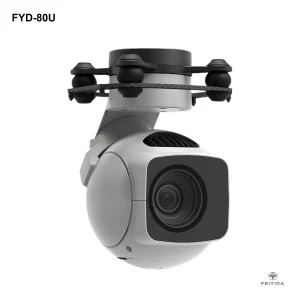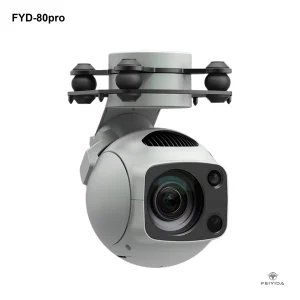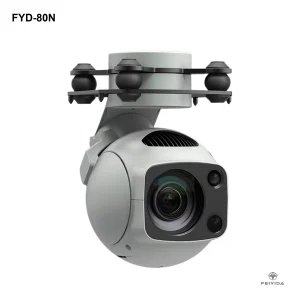
| 429G POD WEIGHT | ±0.01°3-AXIS ACCURACY | 30×HYBRID ZOOM |
| 98.5°WIDE HFOV | 200 mLASER ILLUMINATION | 14–53V INPUT |
Overview
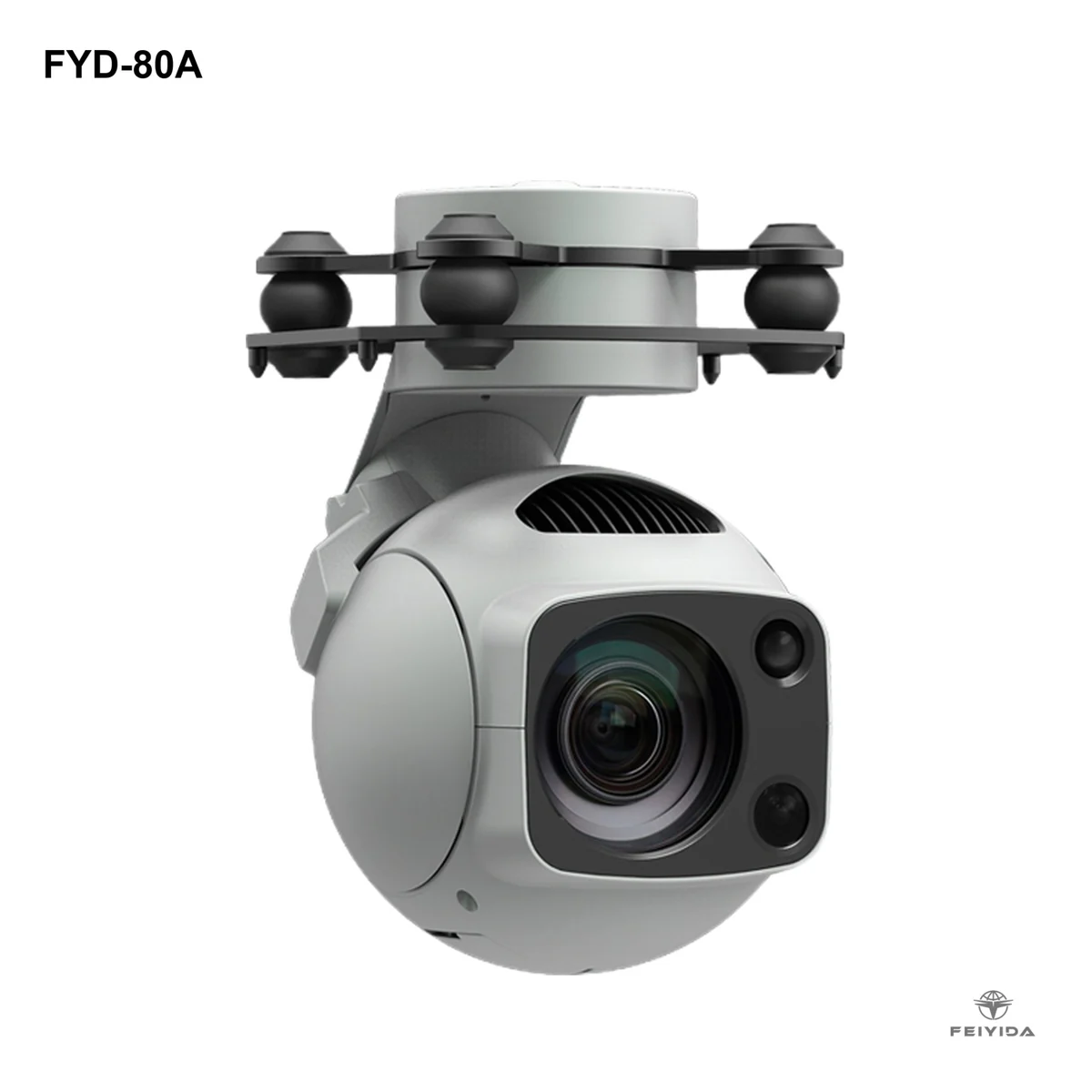
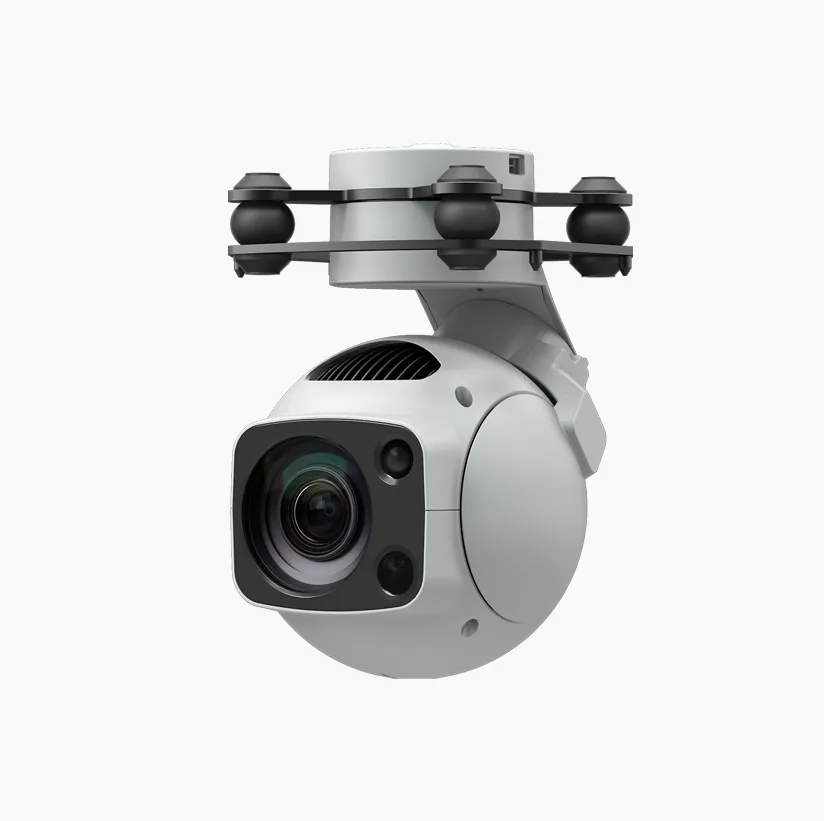
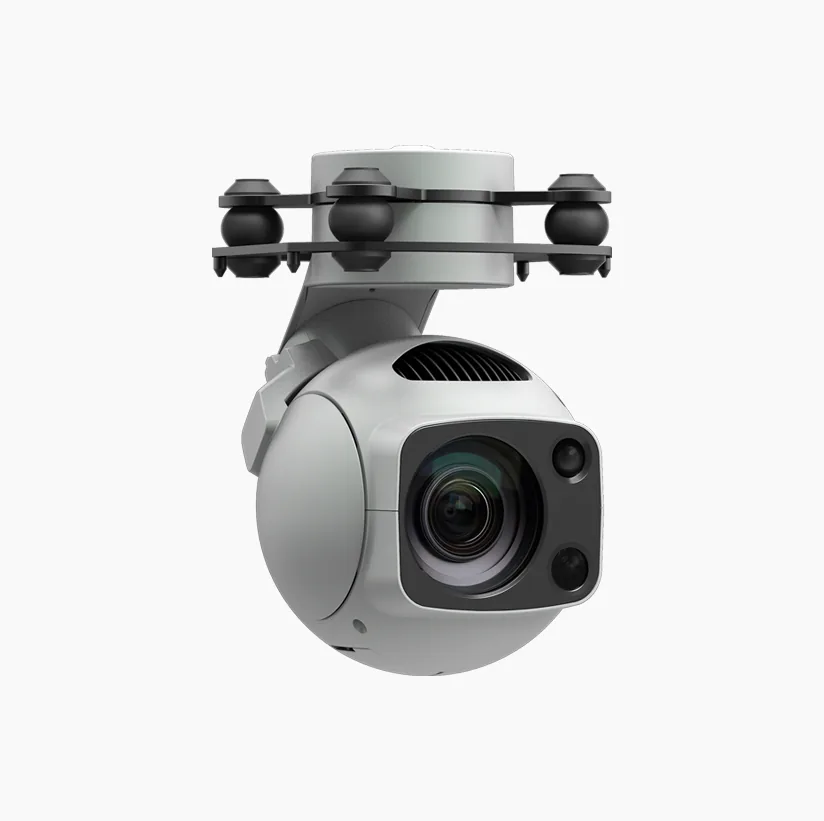
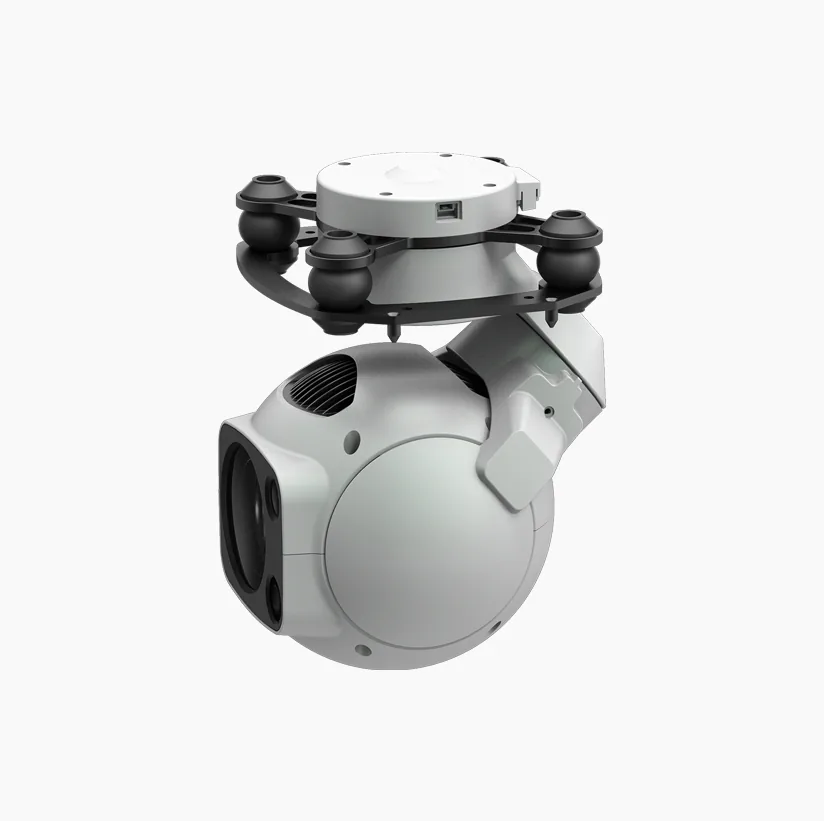
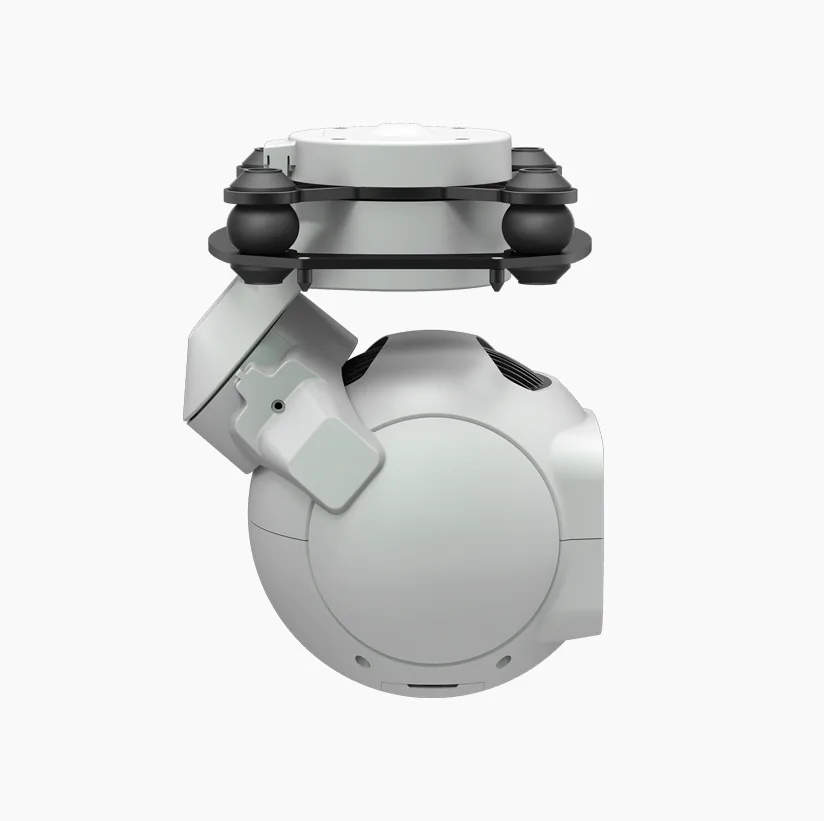
The 80A is an 80 mm sphere on a damper ring — 429 g for the pod, 18.6 g for the control unit, which sits outside the housing on a cable. The lens face carries three apertures: the zoom block, the wide camera and the 850 nm illuminator. Maximum rotation radius is R55.3 mm, and that is the number to check against your airframe first.
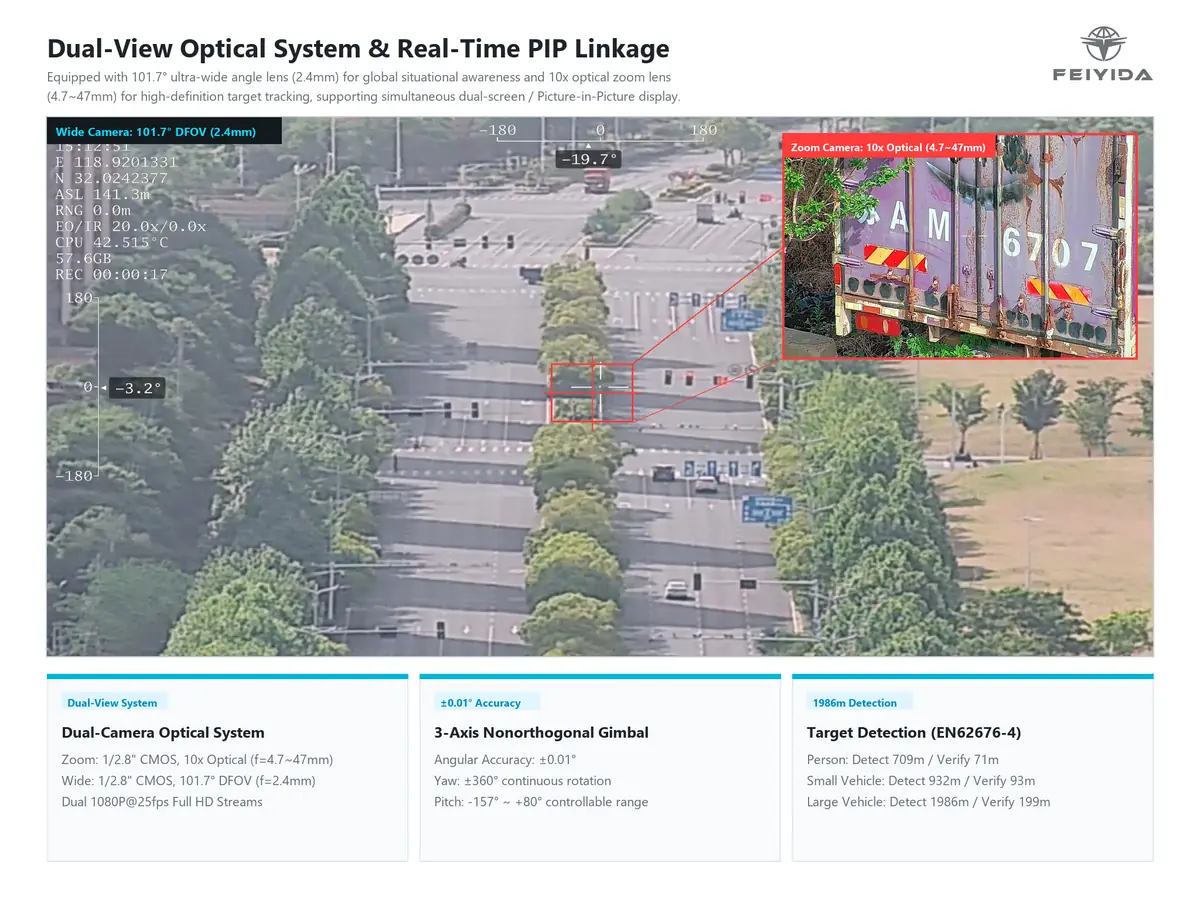
A single zoom lens forces a choice on every flight: wide enough to see where you are going, or long enough to read detail when you get there. Carrying both channels answers that without a second downlink, and picture-in-picture puts both on one stream.
Two things this pod is not. It has no thermal imager; both cameras are visible light. And the 30× figure is 10× optical plus 3× digital.
Camera specification
| Item | Wide camera | Zoom camera |
|---|---|---|
| Sensor | 1/2.8″ CMOS, 2.07 MP | 1/2.8″ CMOS, 2.07 MP |
| Focal length | 2.4 mm | 4.7 – 47 mm |
| Zoom | — | 10× optical (30× hybrid) |
| Field of view | 98.5° × 44.3° | 61.3° × 36.9° → 6.8° × 3.9° |
| Resolution | 1920 × 1080 | 1920 × 1080 |
| Pixel pitch | 2.9 µm | 2.9 µm |
| Min. illumination | — | 0.01 / 0.0015 Lux |
Stabilisation and pointing
| Item | Specification |
|---|---|
| Gimbal type | 3-axis non-orthogonal mechanical stabilization |
| Angular accuracy | ±0.01° |
| Controllable range | Pitch −157° to +80°, yaw ±360° continuous |
| Max. angular speed | ±200°/s, pitch and yaw |
| Installation | Upright or inverted |
Target distance
| Target | Detect | Recognise | Identify |
|---|---|---|---|
| Person | 709 m | 142 m | 71 m |
| Small vehicle | 932 m | 187 m | 397 m |
| Large vehicle | 1986 m | 397 m | 199 m |
Interface and power
| Item | Specification |
|---|---|
| Operating voltage | 14 – 53 VDC |
| Power | 6.7 W average / 55 W stall (illuminator on); GCU 1.8 W |
| Control interface | Ethernet, UART, UART2, S.BUS |
| Protocol | Private protocol, MAVLink |
| Video | 1920 × 1080 @ 25 fps, RTSP, H.264 / H.265; MP4 to microSD ≤ 256 GB |
| Software | Dragonfly, GCU_Config, GimbalConfig, customized QGC |
Mechanical specification
| Item | Specification |
|---|---|
| Dimensions | 85.8 × 86 × 129.3 mm (pod), 45.4 × 40 × 13.5 mm (GCU) |
| Weight | 429 g (pod), 18.6 g (GCU) |
| Sphere / radius | 80 mm diameter, R55.3 mm max rotation |
| Operating temperature | −20 °C to +50 °C; storage −40 °C to +60 °C |
| Ingress protection | Not specified; humidity ≤ 85% RH non-condensing |
What’s in the box
- 1 × FYD-80A pod
- 1 × GCU (gimbal control unit)
- 1 × damper ring and mounting hardware
- 1 × pod-to-GCU cable set, quick start card
How to size it
The radius is the design driver here. R55.3 mm is the maximum rotation radius, and the pod swings to −157° — measure it against the landing gear, the payload rail and the propeller arc before anything else, because a sphere that fouls the gear is not fixable with a firmware update.
Then budget the 55 W transient rather than the 6.7 W average, and put the GCU near the flight controller instead of the payload bay. And check the night requirement honestly: in daylight the 850 nm illuminator is a bonus, but past 200 m at night, or through smoke, this pod cannot see.
FAQ
Does it have a thermal camera?
No. Both cameras are visible light plus an 850 nm illuminator. There is no infrared detector, and no rangefinder, so no target coordinates either.
Is the 30× zoom all optical?
No. 10× optical (4.7–47 mm) plus 3× digital. The digital stage crops and interpolates; resolution comes from the optical range.
Is it waterproof?
No IP rating is claimed and humidity is limited to ≤85% RH non-condensing. Not rated for rain or washdown.
Is the laser eye-safe?
No — Class 3B under IEC 60825-1:2014. It needs warning labelling and access control, and may restrict where you can fly.
What is the 55 W figure?
A transient at stall with the illuminator on. Average draw with the light off is 6.7 W. Size the supply for the transient.
Other configurations
Downloads
- FYD-80A product specification (PDF, 1.4 MB)
Dimensional drawing, general, camera, gimbal, laser, AI tracking, interface and environment specifications, target distance data.