| 398G POD WEIGHT | ±0.01°3-AXIS ACCURACY | 40×HYBRID ZOOM |
| 48.8°WIDE HFOV | 200 mLASER ILLUMINATION | 20–53V INPUT |
Overview
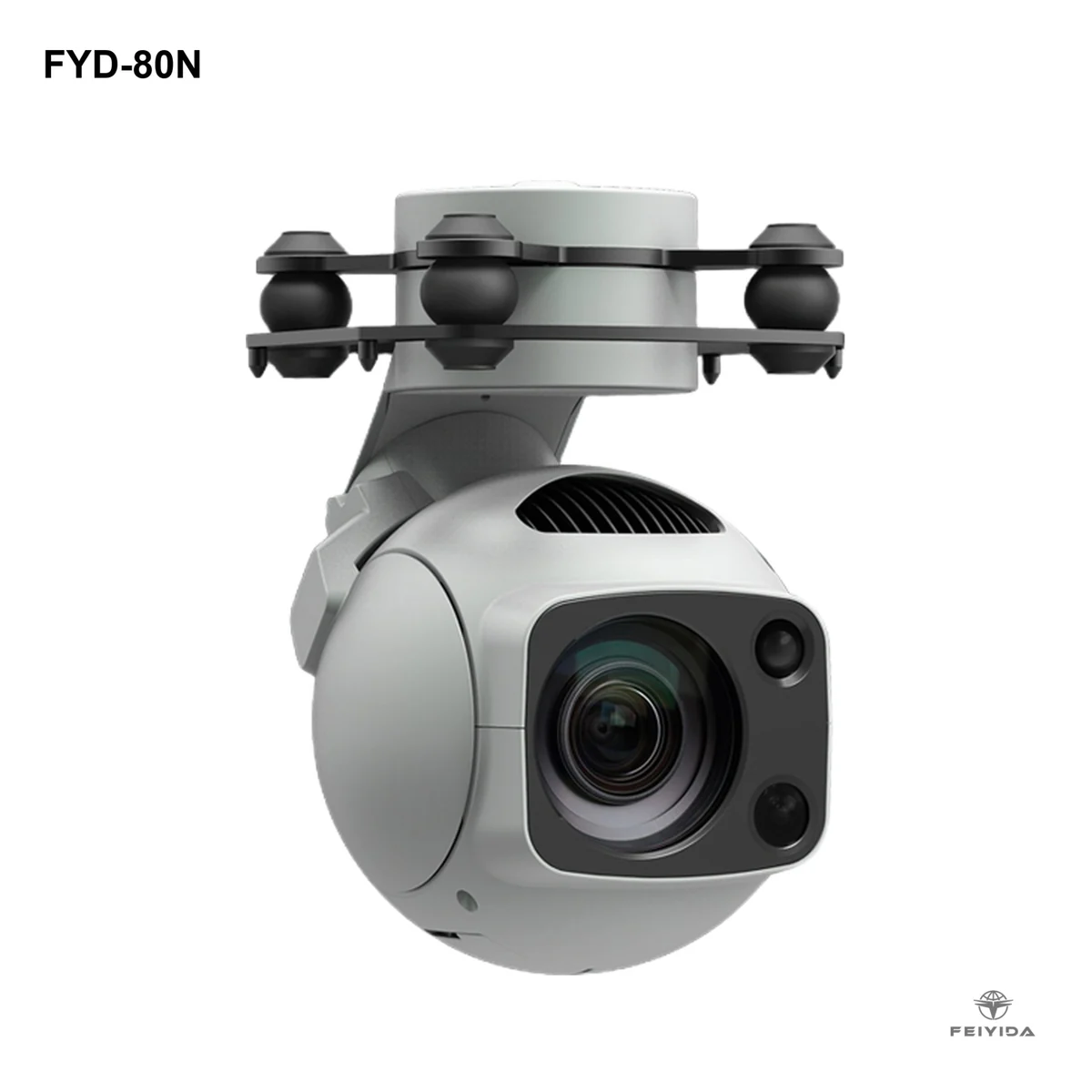
The 80N is an 80 mm sphere on a suspended yoke: 398 g, 89.6 × 86 × 124.6 mm, running 20 to 53 V. It carries one 6.1–61.4 mm zoom lens on a 2.07 MP ultra-starlight sensor, with an 850 nm illuminator beside it and no second camera.
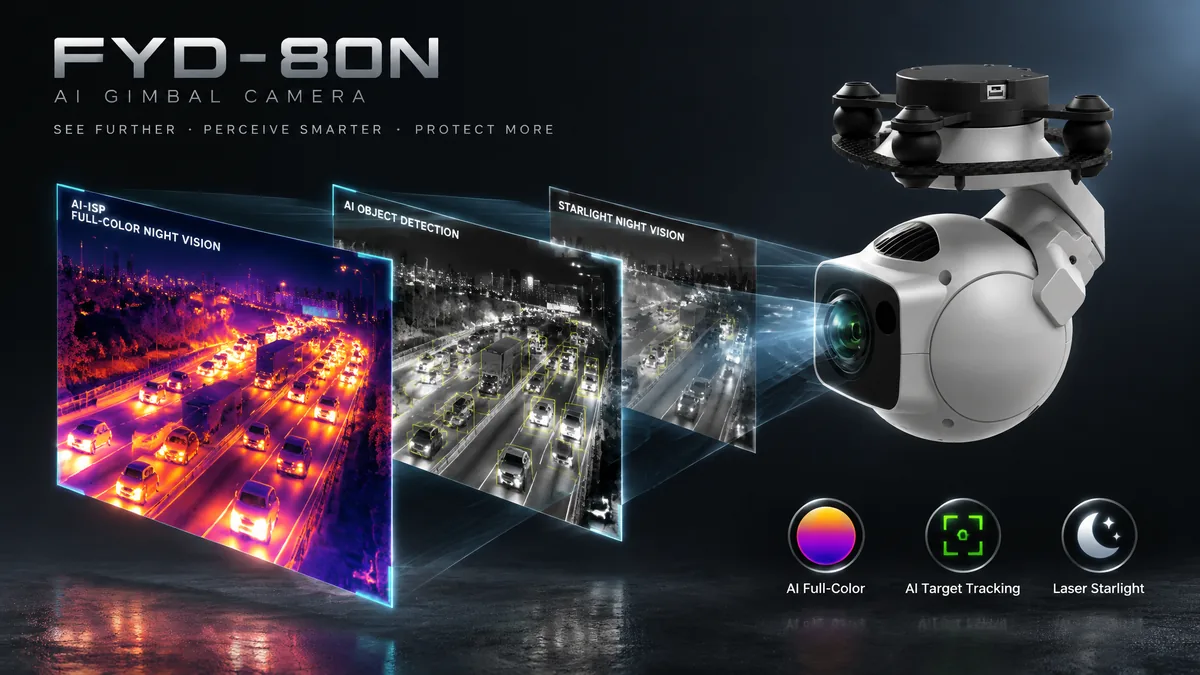
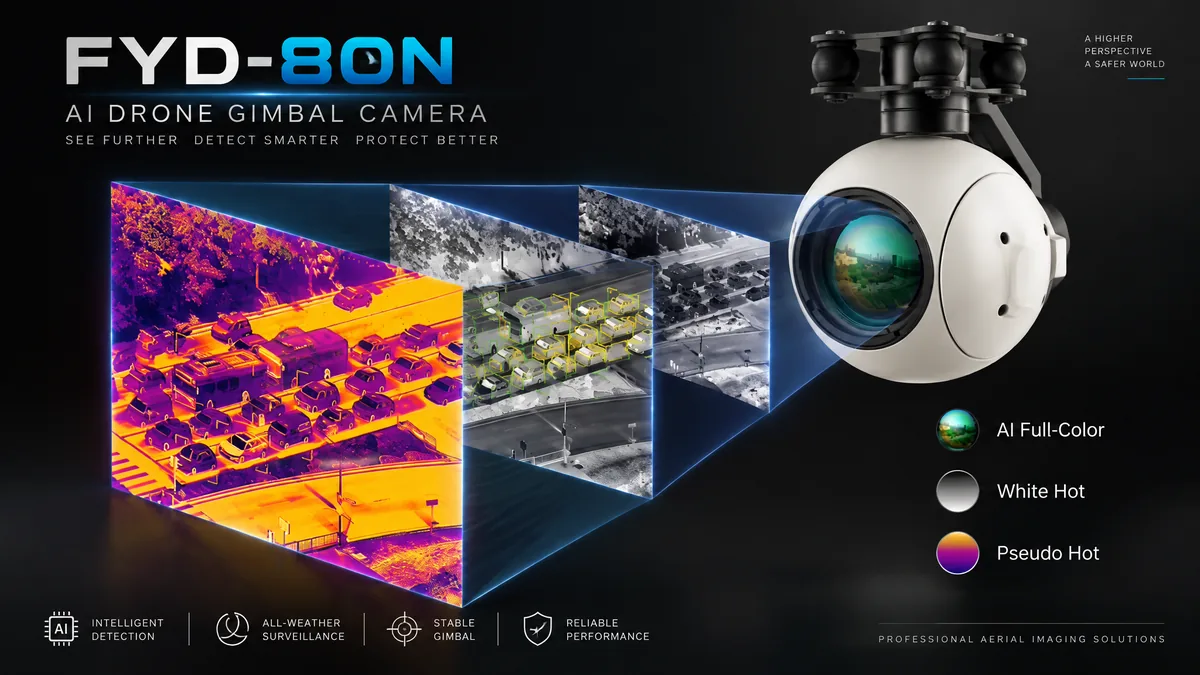
The sensor and the AI-ISP engine are the point of this model. Full-colour night vision keeps colour where a conventional sensor falls back to monochrome, and AI-HDR holds highlight detail in a scene that has both a lamp and a shadow in it.
Two things to size around. The 40× figure is 10× optical plus 4× digital, and output is 1920 × 1080 at 30 fps — this is not the 4K build.
Camera specification
| Item | Specification |
|---|---|
| Sensor | 1/2.8″ CMOS, 2.07 MP, ultra starlight |
| Focal length | 6.1 – 61.4 mm (equivalent 41.6 – 415.8 mm) |
| Aperture | f/1.8 – f/2.6 |
| Field of view | HFOV 48.8° → 5.2°, VFOV 28.6° → 2.9°, DFOV 55.0° → 6.0° |
| Resolution | 1920 × 1080 |
| Pixel pitch | 2.9 µm |
| Zoom | 10× optical + 4× digital (40× hybrid) |
| Image engine | AI-ISP full-colour night vision, AI-HDR |
Stabilisation and pointing
| Item | Specification |
|---|---|
| Gimbal type | 3-axis non-orthogonal mechanical stabilization |
| Angular accuracy | ±0.01° |
| Controllable range | Pitch −145° to +60°, yaw ±360° continuous |
| Max. angular speed | 150°/s |
| Max. stabilisation tilt | 45° |
| Installation | Suspended or upright |
Target distance
| Target | Detect | Recognise | Identify |
|---|---|---|---|
| Person | 927 m | 185 m | 93 m |
| Small vehicle | 1218 m | 244 m | 122 m |
| Large vehicle | 2595 m | 519 m | 260 m |
Interface and power
| Item | Specification |
|---|---|
| Operating voltage | 20 – 53 VDC |
| Power | 6.5 W average (illuminator off) / 28.2 W stall (illuminator on) |
| Control interface | Network / serial / S.BUS |
| Protocol | Private protocol, MAVLink |
| Video | 1920 × 1080 @ 30 fps, RTSP, H.264 / H.265; MP4 to microSD ≤ 256 GB (U3 / V30) |
| Stream latency | 190 – 200 ms (Dragonfly), 230 – 250 ms (QGC) |
| Software | Dragonfly / XF-QGC |
Mechanical specification
| Item | Specification |
|---|---|
| Dimensions | 89.6 × 86 × 124.6 mm |
| Weight | 398 g |
| Sphere diameter | 80 mm |
| Operating temperature | −20 °C to +50 °C; storage −40 °C to +60 °C |
| Ingress protection | Not specified; humidity ≤ 85% RH non-condensing |
What’s in the box
- 1 × FYD-80N pod
- 1 × damper ring and mounting hardware
- 1 × cable set
- 1 × quick start card (software download link)
How to size it
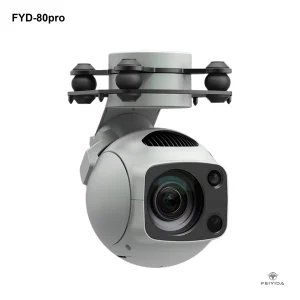
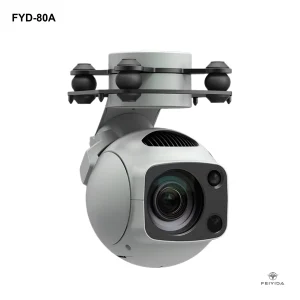
The tilt envelope is the first check. The stabiliser is specified to 45°, so anything that expects the pod to look far behind and below itself needs a different model — the 80A and 80Pro both reach −157°.
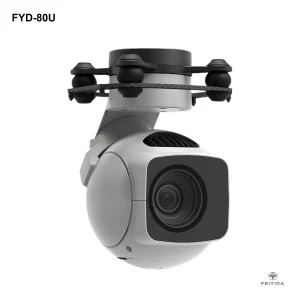
Then decide whether 1080p is enough. Full-colour night vision at 1920 × 1080 is the reason to buy this pod; if the deliverable is a 4K recording rather than a live decision, the 80Pro or 80U is the right build.
FAQ
Does it have a thermal camera?
No. It is a visible-light pod: a zoom camera plus an 850 nm illuminator. There is no infrared detector, and no rangefinder, so no target coordinates either.
Is the 40× zoom all optical?
No. 10× optical (6.1–61.4 mm) plus 4× digital. The digital stage crops and interpolates; resolution comes from the optical range.
Is it waterproof?
No IP rating is claimed and humidity is limited to ≤85% RH non-condensing. Not rated for rain or washdown.
Is the laser eye-safe?
850 nm sits outside human vision, so the illuminator does not give the aircraft position away and the scene stays lit for the sensor. Class 3B under IEC 60825-1:2014 is not eye-safe: it needs warning labelling and access control, and may restrict operation.
What is the 28.2 W figure?
A transient at stall with the illuminator on. Average draw with the light off is 6.5 W. Size the supply for the transient.
Other configurations
Downloads
- FYD-80N product specification (PDF, 1.1 MB)
Dimensional drawing, general, gimbal, camera, laser, AI tracking, interface and environment specifications, target distance data.