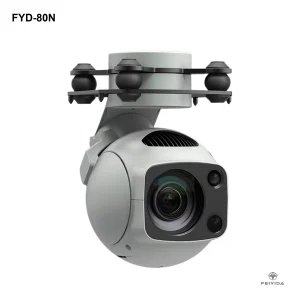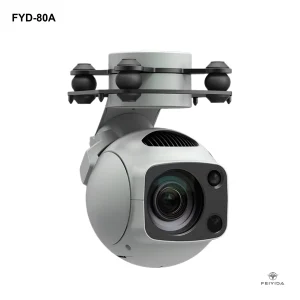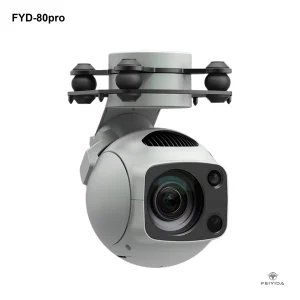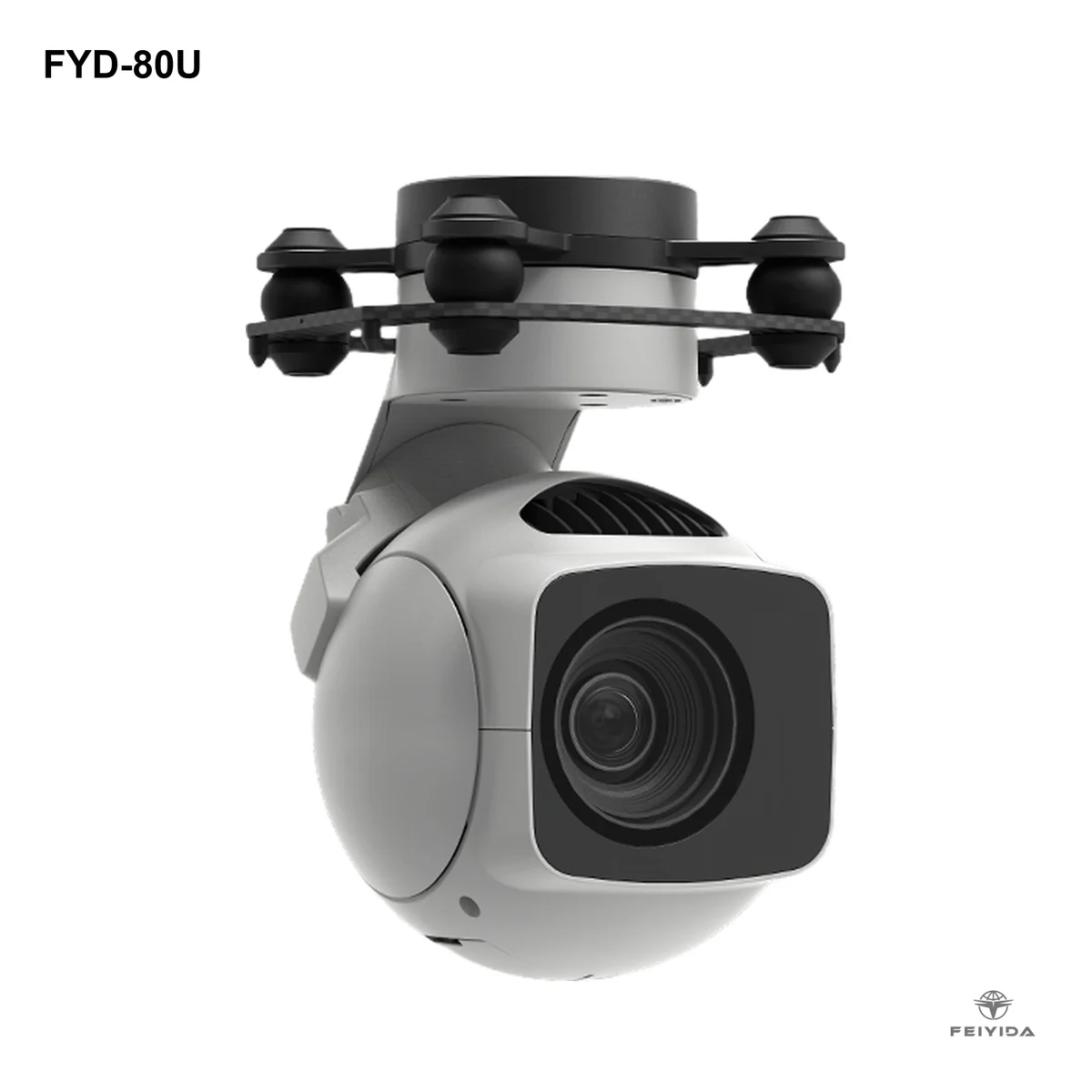
| 398G POD WEIGHT | ±0.01°3-AXIS ACCURACY | 80×HYBRID ZOOM |
| 4KRESOLUTION | 30 HzAI TRACKING | 20–53V INPUT |
Overview
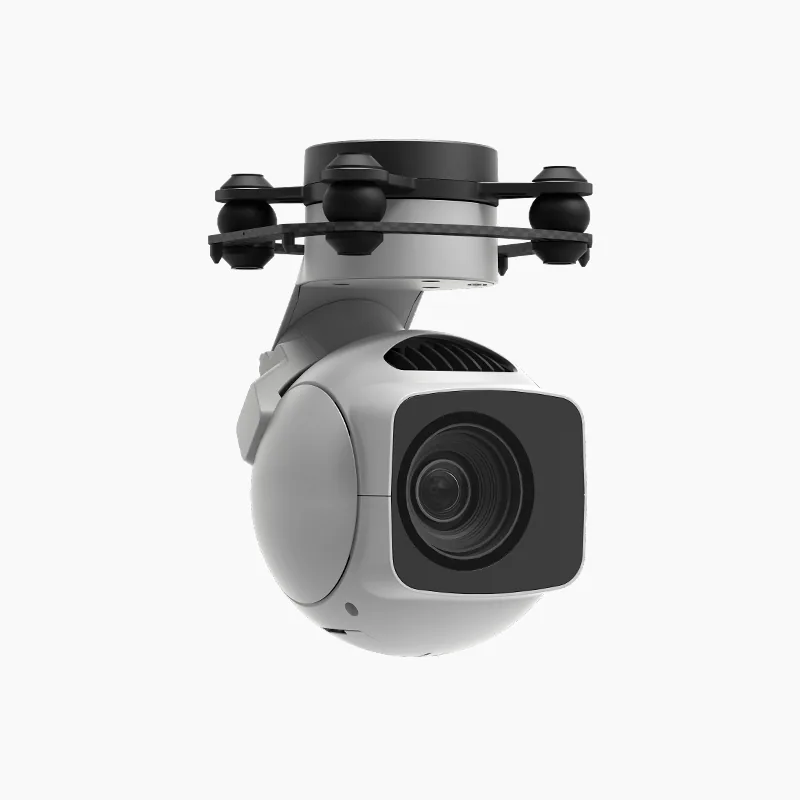
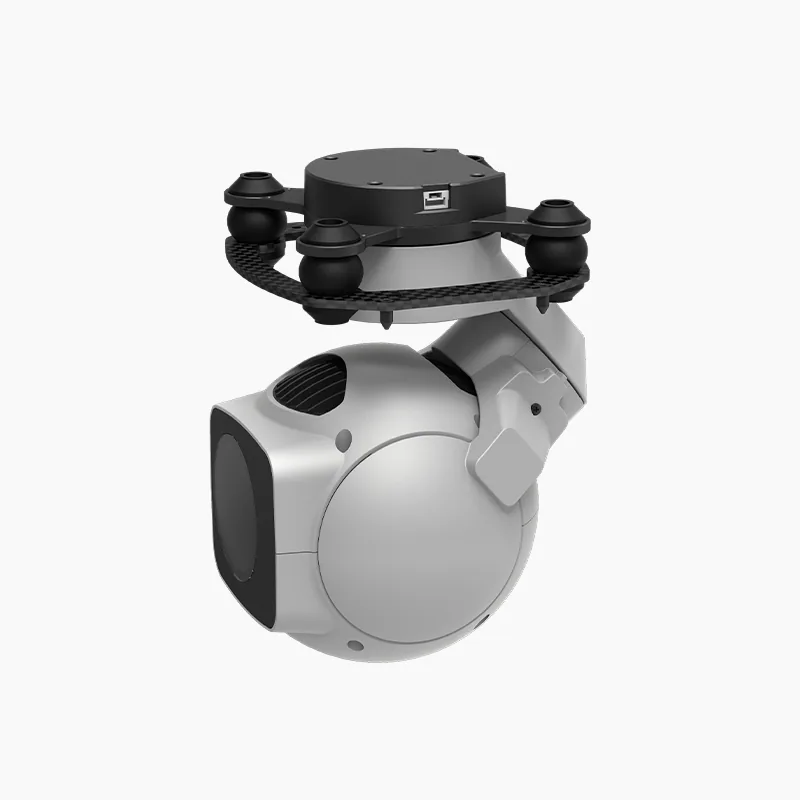
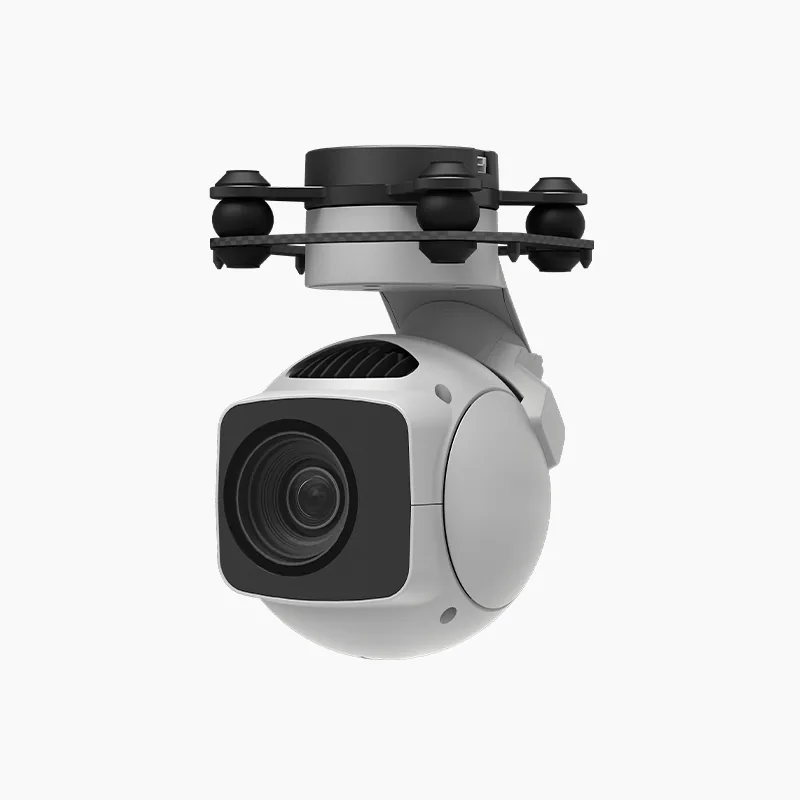
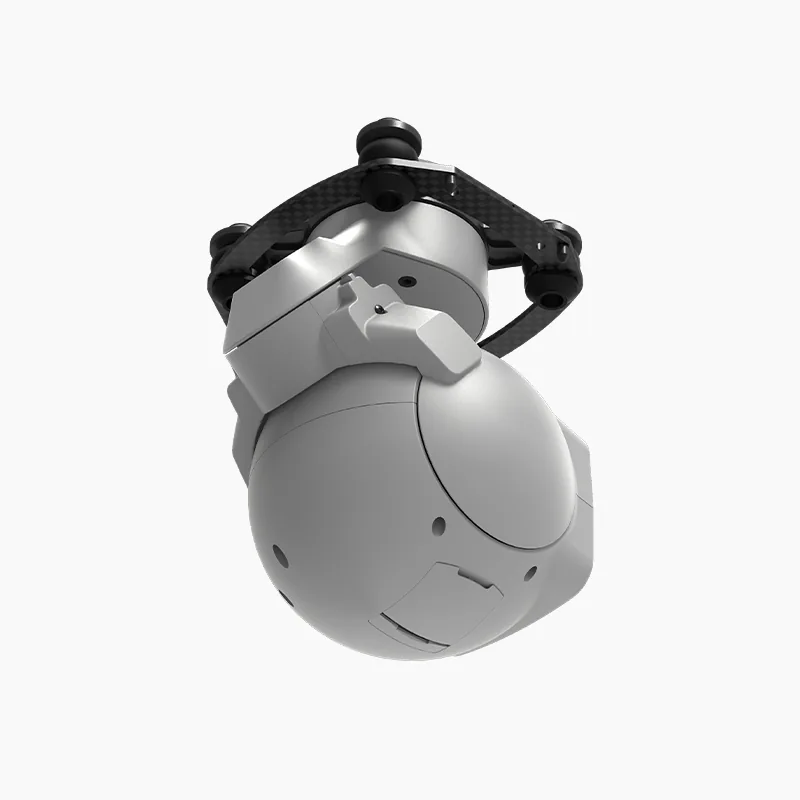
The 80U is the top of the series: an 80 mm sphere on a suspended yoke, 398 g, 89.6 × 86 × 124.6 mm, running 20 to 53 V. It pairs a 6.1–61.4 mm zoom lens with an 8.29 MP sensor, adds AI-ISP full-colour night vision and AI multi-object tracking.
It is the only model in the series with 80× hybrid zoom — 10× optical plus 8× digital — and the only one that streams 4K while also carrying the night-vision engine and the AI module.
Three things to size around. There is no laser illuminator on this model. Recording is 1920 × 1080 at 30 fps, with 4K recording available through a firmware upgrade. And the frame rate falls when OSD and AI are both on.
Camera specification
| Item | Specification |
|---|---|
| Sensor | 1/2.8″ CMOS, 8.29 MP |
| Focal length | 6.1 – 61.4 mm (equivalent 41.6 – 415.8 mm) |
| Aperture | f/1.8 – f/2.6 |
| Field of view | HFOV 48.8° → 5.2°, VFOV 28.6° → 2.9°, DFOV 55.0° → 6.0° |
| Resolution | 3840 × 2160 |
| Pixel pitch | 1.45 µm |
| Zoom | 10× optical + 8× digital (80× hybrid) |
| Image engine | AI-ISP full-colour night vision, AI-HDR |
Stabilisation and pointing
| Item | Specification |
|---|---|
| Gimbal type | 3-axis non-orthogonal mechanical stabilization |
| Angular accuracy | ±0.01° |
| Controllable range | Pitch −145° to +60°, yaw ±360° continuous |
| Max. angular speed | 150°/s |
| Max. stabilisation tilt | 45° |
| Installation | Suspended or upright |
Target distance
| Target | Detect | Recognise | Identify |
|---|---|---|---|
| Person | 1854 m | 371 m | 185 m |
| Small vehicle | 2436 m | 487 m | 244 m |
| Large vehicle | 5190 m | 1038 m | 519 m |
Interface and power
| Item | Specification |
|---|---|
| Operating voltage | 20 – 53 VDC |
| Power | 6.5 W average / 23.4 W stall |
| Control interface | Network / serial / S.BUS |
| Protocol | Private protocol, MAVLink |
| Video stream | 3840 × 2160 @ 30 fps, RTSP, H.264 / H.265 |
| Recording | 1920 × 1080 @ 30 fps to microSD ≤ 256 GB (U3 / V30); 4K via firmware upgrade |
| Stream latency | 210 ms (Dragonfly) to 530 ms (OSD + AI on) |
| Frame rate | 30 fps AI off, 21 fps AI on with OSD off, 13 fps with OSD and AI on |
| Software | Dragonfly / XF-QGC |
Mechanical specification
| Item | Specification |
|---|---|
| Dimensions | 89.6 × 86 × 124.6 mm |
| Weight | 398 g |
| Operating temperature | −20 °C to +50 °C; storage −40 °C to +60 °C |
| Ingress protection | Not specified; humidity ≤ 85% RH non-condensing |
What’s in the box
- 1 × FYD-80U pod
- 1 × damper ring and mounting hardware
- 1 × cable set
- 1 × quick start card (software download link)
How to size it
The tilt envelope is the first check: 45° of stabilisation, so anything that expects the pod to look far behind and below itself needs the 80A or 80Pro, which reach −157°.
Then decide how much you are willing to trade for 80×. Digital reach, 4K streaming and AI tracking all draw on the same processor, which is why the frame rate steps down as OSD and AI come on. If the deliverable is 4K recording rather than live tracking, the 80Pro does that more cleanly.
FAQ
Does it have a thermal camera?
No. It is a visible-light pod with an AI-ISP full-colour night-vision engine. There is no infrared detector, no laser illuminator and no rangefinder on this model.
Is the 80× zoom all optical?
No. 10× optical (6.1–61.4 mm) plus 8× digital. The digital stage crops and interpolates; resolution comes from the optical range.
Does it really output 4K?
It streams 3840 × 2160 at 30 fps. On-board recording is 1920 × 1080 at 30 fps, with 4K recording available through a firmware upgrade.
Why does the frame rate drop?
The night-vision engine, OSD and AI tracking share the processor. 30 fps with AI off, 21 fps with AI on and OSD off, 13 fps with both on.
Is it waterproof?
No IP rating is claimed and humidity is limited to ≤85% RH non-condensing. Not rated for rain or washdown.
Other configurations
Downloads
- FYD-80U product specification (PDF, 1.1 MB)
Dimensional drawing, general, gimbal, camera, AI tracking, image and video, storage, environment specifications, target distance data.