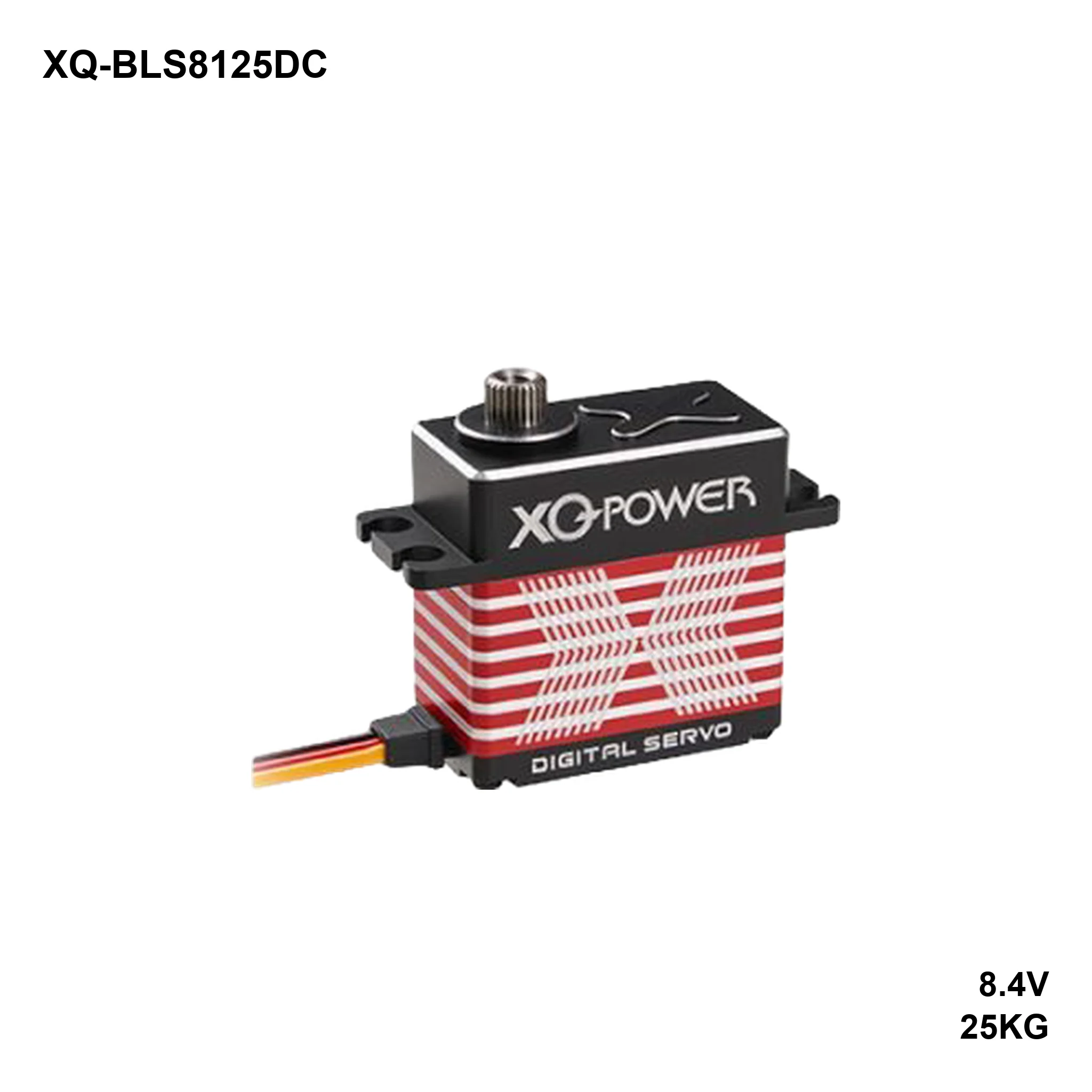
| 25KG·CM STALL | 0.070S/60° NO-LOAD | 8.4V RATED |
| 77G WEIGHT | StainlessGEARTRAIN | 360°TRAVELCustomizable |
Overview
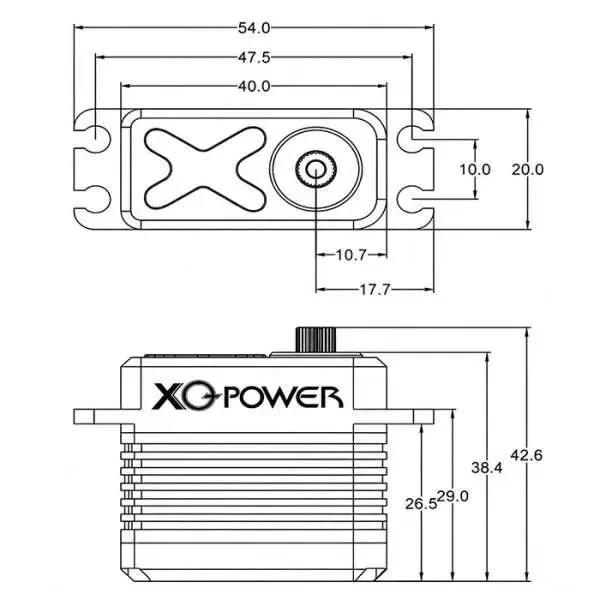
The BLS8125D is a 25 kg·cm brushless servo in the standard 20 × 40 × 38.4 mm case, 77 g. It is the direct brushless alternative to a coreless servo of the same size: same mounting, same 25T output, no brushes to wear.
The geartrain is stainless steel on two ball bearings, the horn is POM, and the case is CNC aluminium with the fins cut into the sides. The mechanical limit is 210°, the dead band is 1 µs, and the pulse window is the standard 800–2200 µs.
This page covers the CAN build: the same mechanics on a CAN bus, with arbitration and error checking handled in hardware. The version to pick when the machine already speaks CAN and a dropped frame must not become a wrong angle.
Performance at each supply voltage
| Supply | No-load speed | Peak stall torque | Idle current | Stall current |
|---|---|---|---|---|
| 6.0 V | 0.120 s/60° (500 °/s) | 18 kg·cm (1.77 N·m / 250 oz·in) | 300 mA | 2.8 A |
| 7.4 V | 0.090 s/60° (667 °/s) | 22 kg·cm (2.16 N·m / 306 oz·in) | 350 mA | 3.5 A |
| 8.4 V | 0.070 s/60° (857 °/s) | 25 kg·cm (2.45 N·m / 347 oz·in) | 410 mA | 4.0 A |
Control specification
| Item | Specification |
|---|---|
| Command signal | CAN bus |
| Amplifier | Digital controller |
| Dead band | 1 µs |
| Rotating direction | CCW (1000–2000 µs) |
| Travel | 360°, customizable |
Mechanical specification
| Item | Specification | Item | Specification |
|---|---|---|---|
| Dimensions | 20 × 40 × 38.4 mm | Case material | Aluminium, CNC |
| Weight | 77 g | Geartrain | Stainless steel |
| Bearings | 2 × ball bearing | Motor | Brushless |
| Output spline | 25T-φ5.94 mm | Horn | Plastic, POM |
| Lead / connector | 300 mm, 3-wire | Mechanical limit | 210° |
| Operating temperature | −15 °C to 65 °C | Storage temperature | −20 °C to 70 °C |
| Ingress protection | Splash resistant (customizable) | Travel | 360°, customizable |
What’s in the box
- 1 × XQ-BLS8125DC servo
- 1 × POM horn set
- 1 × mounting screw pack
Optional: metal horn, sold separately.
How to size it
Torque tracks the rail: 18 kg·cm at 6.0 V, 22 at 7.4 V, 25 at 8.4 V. On a 2S pack that sits at 7.4 V under load, plan around 22 kg·cm and treat 25 as the fresh-pack figure.
Stall current is 4 A at 8.4 V against 410 mA no-load. Four of these on one BEC is 16 A at stall — the usual cause of a receiver brownout is exactly this, not the servo.
FAQ
How does it compare with a coreless servo of the same size?
Same 20 × 40 mm footprint and 25T spline, but no brushes to wear: service life is set by bearings and gears. It also runs cooler at the same output, which is what allows a fully sealed case.
What supply voltage?
6.0 to 8.4 V. The 25 kg·cm headline is the 8.4 V figure; at 7.4 V it is 22 kg·cm.
What bitrate and message set does it use?
Not printed on the inspection sheet. Ask for the CAN message set, bitrate options and node ID range before integration; they are supplied on request.
Why CAN instead of RS-485?
Arbitration and error detection are in hardware, so a corrupted frame is discarded rather than acted on, and several nodes can share the bus without a master polling loop.
Other interfaces
Downloads
- XQ-BLS8125DC inspection specification (PDF, 767 KB)
Torque, speed and current at each supply voltage, mechanical data, control specification, mounting dimensions. - 2D dimension drawing (image)
Mounting hole positions, case depth and overall height; the same drawing is inside the datasheet.