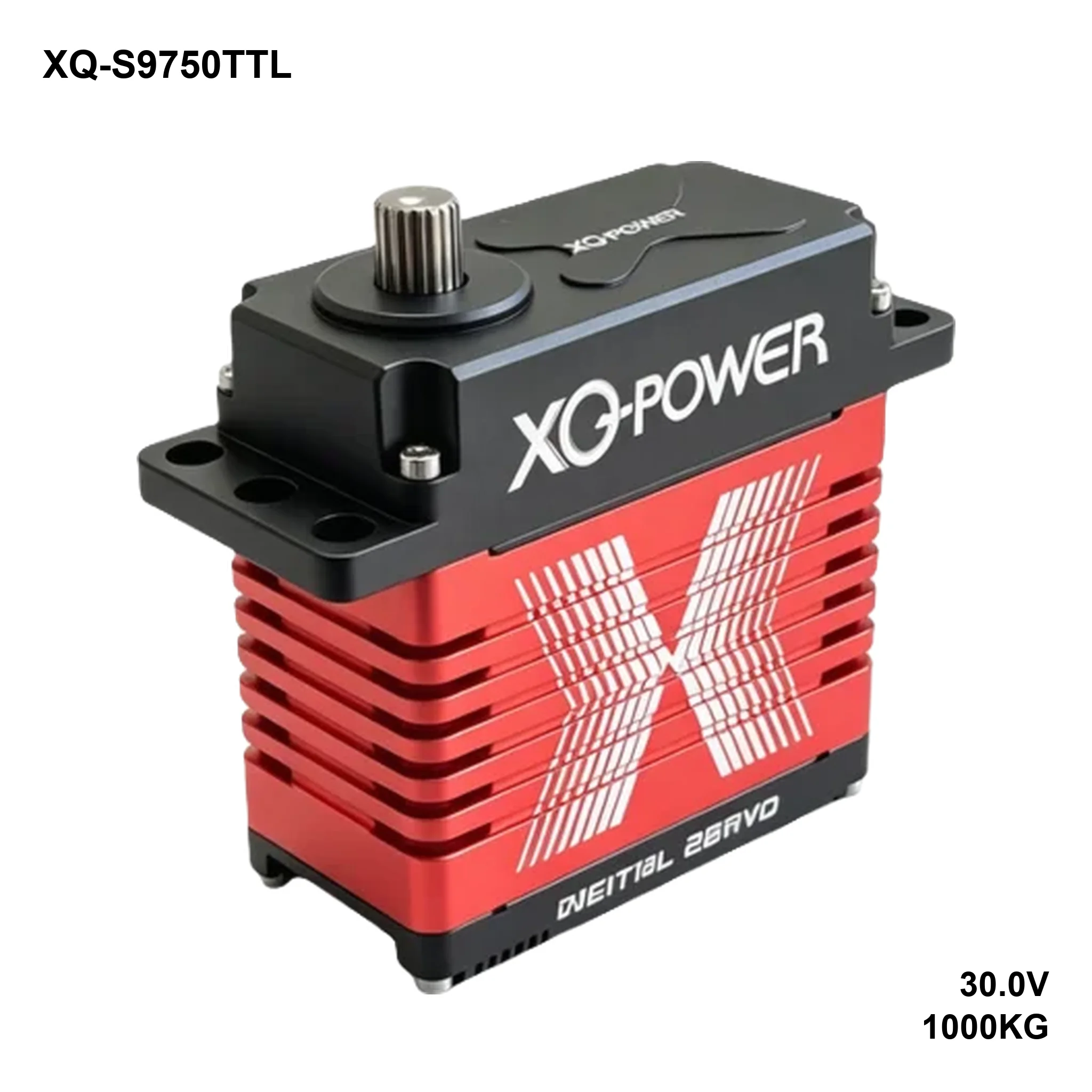
| 980KG·CM STALL1000 peak | 0.250S/60° NO-LOAD | 30V RATED |
| 1750G WEIGHT | SteelGEARTRAIN | 360°TRAVELCustomizable |
Overview
For reference, the 9750D sits at the top of the range: a 30 V brushless servo rated 980 kg·cm, with a 1000 kg·cm momentary limit. Despite the size, it weighs 1750 g in a 120 × 60 × 111.5 mm milled aluminium body with a red anodised fin stack. Inspection data, however, puts the figure at 980 kg·cm at 30 V. Product photos print 1000 kg·cm because that is the peak the servo will hold for a short overload. Treat it therefore as a ceiling for the linkage, not as the number you build a static design around.
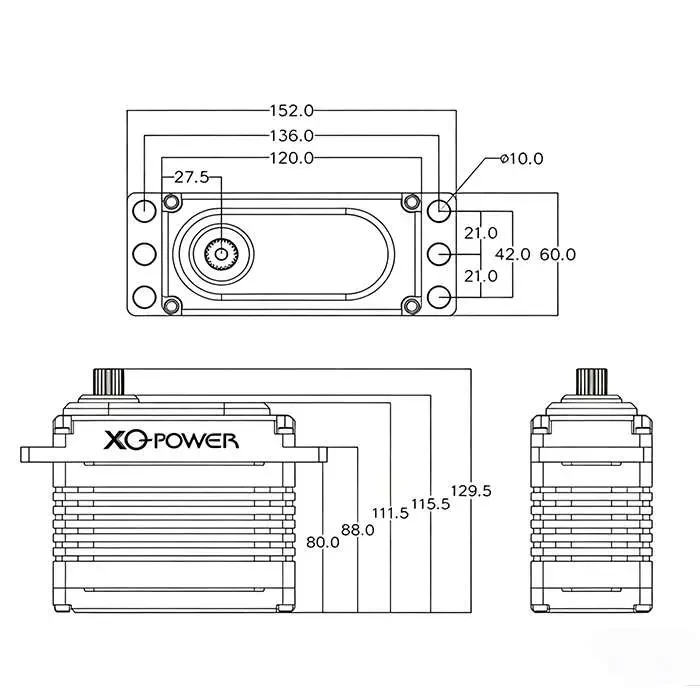
Because the loads are high, ten ball bearings carry the geartrain, and the output runs a 25T-φ14.98 mm spline — the largest in the line. Mounting is four φ10 mm through-holes on a 136 mm span, so this is a part you bolt to a steel bracket rather than a tray, and the electrical interface is a socket with the harness supplied separately.
This page covers the TTL build: the same mechanics, commanded over a serial bus so several servos can share one signal line and be addressed individually. Useful when the actuator count outgrows the PWM channels available.
Performance at each supply voltage
| Supply | No-load speed | Peak stall torque | Idle current | Stall current |
|---|---|---|---|---|
| 24 V | 0.350 s/60° (171 °/s) | 850 kg·cm (83.39 N·m / 11804 oz·in) | 400 mA | 21 A |
| 28 V | 0.280 s/60° (214 °/s) | 920 kg·cm (90.25 N·m / 12776 oz·in) | 460 mA | 25 A |
| 30 V | 0.250 s/60° (240 °/s) | 980 kg·cm (96.14 N·m / 13609 oz·in) | 500 mA | 26.5 A |
980 vs 1000: On the inspection sheet the stall torque measures 980 kg·cm at 30 V. Product photos print 1000 kg·cm, however, because that is the momentary limit. That limit applies only to a short overload, so size brackets and linkages against 980.
Control specification
| Item | Specification |
|---|---|
| Command signal | TTL serial |
| Amplifier | Digital controller |
| Dead band | 3 µs |
| Rotating direction | CCW (1000–2000 µs), customizable |
| Travel | 360°, customizable |
Mechanical specification
| Item | Specification | Item | Specification |
|---|---|---|---|
| Dimensions | 120 × 60 × 111.5 mm | Case material | Aluminium, CNC |
| Weight | 1750 g | Geartrain | Steel |
| Bearings | 10 × ball bearing | Motor | Brushless |
| Output spline | 25T-φ14.98 mm | Horn | Metal |
| Lead / connector | Socket, cable sold separately | Mechanical limit | No limit |
| Operating temperature | −30 °C to 60 °C | Storage temperature | −30 °C to 70 °C |
| Ingress protection | Splash resistant (customizable) | Travel | 360°, customizable |
What’s in the box
- 1 × XQ-S9750TTL servo
- 1 × 7075 aluminium horn
- 1 × mounting screw pack
How to size it
Above all, the current is the constraint. Because 26.5 A flows at stall, the supply, the cable and the connector all have to be rated for it; a 4 mm² pair is the practical minimum at a couple of metres. Also do not share the rail with the controller’s logic supply.
Torque therefore scales with the rail: 850 kg·cm at 24 V, 920 at 28 V, 980 at 30 V. A 24 V machine gives up 13% of the headline torque, so size the linkage at 850 if that is the rail the machine holds under load. The 1000 kg·cm peak is, however, a separate number. It is the brief overload ceiling, not a working figure. Designing a linkage at 1000 therefore leaves no margin for the machine.
FAQ
Is it 1000 kg·cm or 980?
Both numbers are real, and they describe different conditions. 980 kg·cm is the stall torque measured at 30 V on the inspection sheet. Design the linkage around that figure. The 1000 kg·cm figure is the momentary limit — the peak the servo will hold for a short overload. Product photos print that same number. Continuous or repeated loading should therefore stay at or below 980; keep the 1000 for peaks.
What supply does it need?
24 to 30 V DC, capable of 26.5 A at stall. This is not a receiver-pack servo, so it will not run from a BEC.
Is the pulse width table valid for this unit?
No. The microsecond window printed on the inspection sheet belongs to the PWM build of the same servo. This unit is commanded over the serial bus — ask for the command set and register map before writing firmware.
How many can share one bus?
The limit is the address space and the current budget of the shared supply, not the signal pair. Keep the bus ground common with the power ground at a single point.
Other interfaces
Downloads
- XQ-S9750TTL inspection specification (PDF, 1094 KB)
Torque, speed and current at each supply voltage, mechanical data, control specification, mounting dimensions. - 2D dimension drawing (image)
Mounting hole positions, case depth and overall height; the same drawing is inside the datasheet.