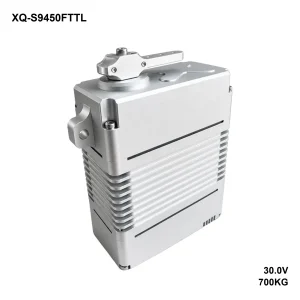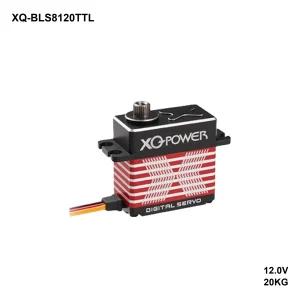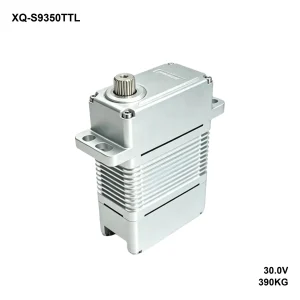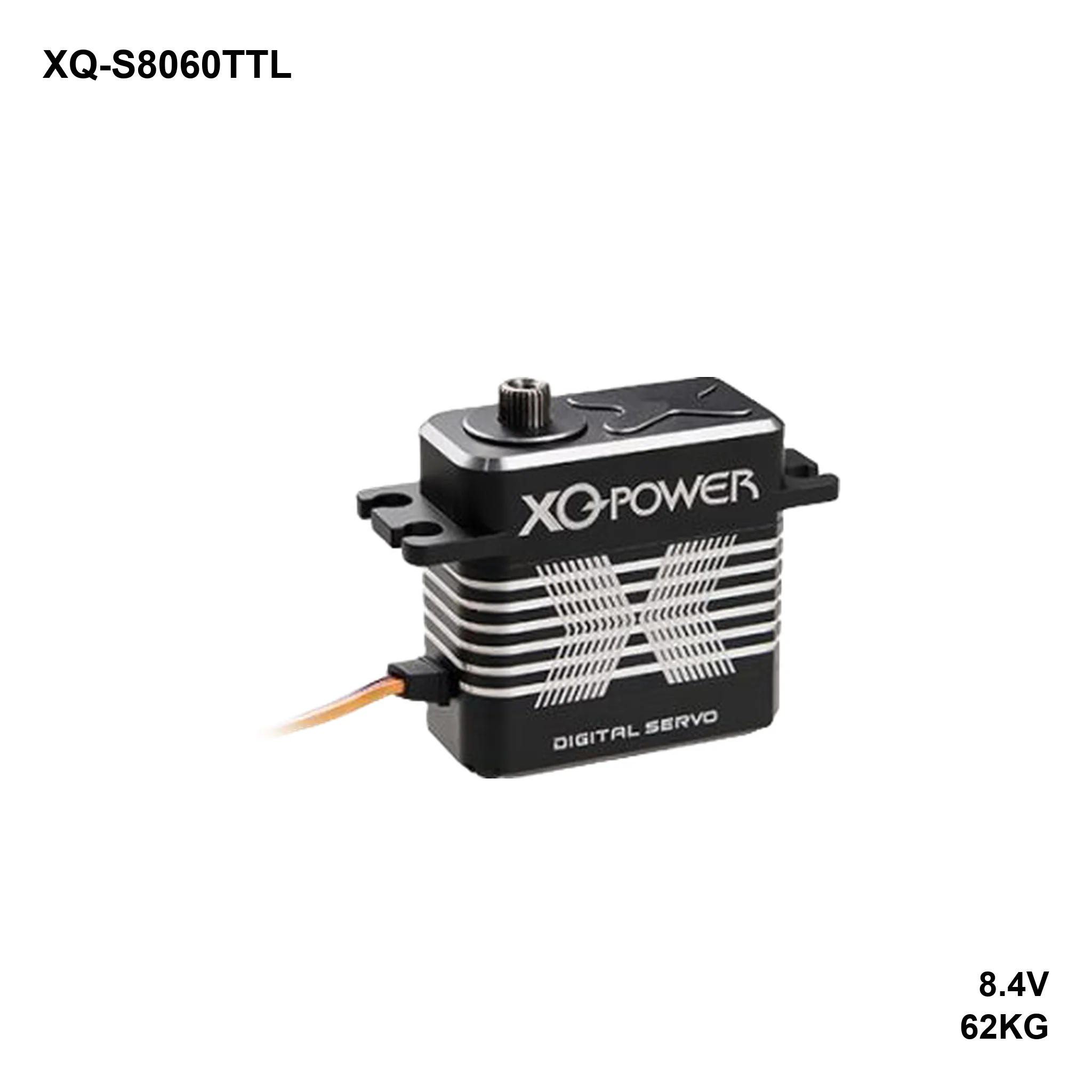
| 62KG·CM STALL | 0.136S/60° NO-LOAD | 8.4V RATED |
| 81G WEIGHT | StainlessGEARTRAIN | 360°TRAVELCustomizable |
Overview
The XQ-S8060TTL is the serial build of the 62 kg·cm coreless servo: identical case, geartrain and motor to the S8060D, with the PWM front end replaced by a TTL bus interface so several servos can sit on one signal line and be addressed individually.
That matters when the servo count outgrows the receiver. A twelve-servo airframe needs twelve PWM channels and a power distribution board; on TTL it needs one signal pair plus an ID per node, and the bus still reports position back.
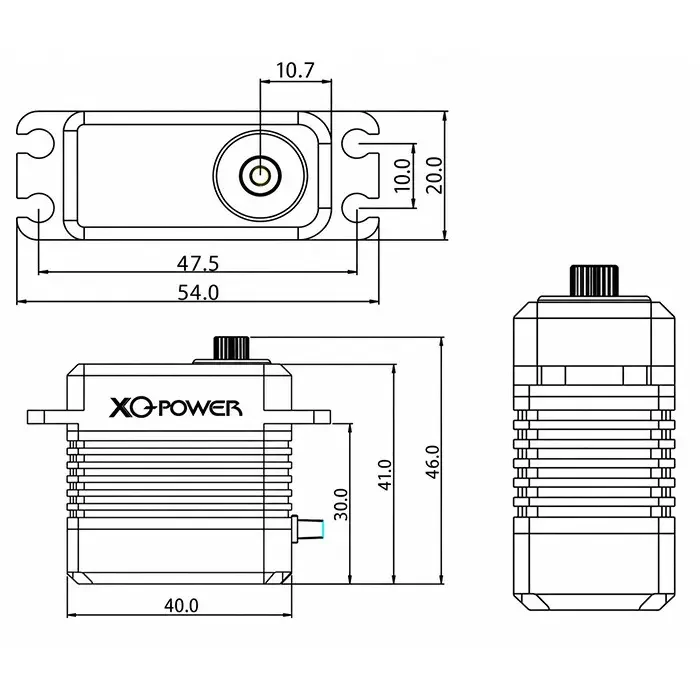
Mechanically it is the same 20 × 40 × 41 mm, 81 g package on two ball bearings with a 25T-φ5.94 output spline. Sealing is splash resistant on the production build; submersion is not covered.
Performance at each supply voltage
| Supply | No-load speed | Peak stall torque | Idle current | Stall current |
|---|---|---|---|---|
| 6.0 V | 0.180 s/60° (333 °/s) | 48 kg·cm (4.71 N·m / 667 oz·in) | 350 mA | 4.4 A |
| 7.4 V | 0.158 s/60° (380 °/s) | 55 kg·cm (5.40 N·m / 764 oz·in) | 390 mA | 5.4 A |
| 8.4 V | 0.136 s/60° (441 °/s) | 62 kg·cm (6.08 N·m / 861 oz·in) | 450 mA | 6.2 A |
Control specification
| Item | Specification |
|---|---|
| Command signal | TTL serial |
| Amplifier | Digital controller |
| Dead band | 1 µs |
| Rotating direction | CCW (1000–2000 µs) |
| Travel | 360°, customizable |
Mechanical specification
| Item | Specification | Item | Specification |
|---|---|---|---|
| Dimensions | 20 × 40 × 41 mm | Case material | Aluminium, CNC |
| Weight | 81 g | Geartrain | Stainless steel |
| Bearings | 2 × ball bearing | Motor | Coreless |
| Output spline | 25T-φ5.94 mm | Horn | Plastic, POM |
| Lead / connector | 300 mm | Mechanical limit | 210° |
| Operating temperature | −15 °C to 65 °C | Storage temperature | −20 °C to 70 °C |
| Ingress protection | Splash resistant (customizable) | Travel | 360°, customizable |
What’s in the box
- 1 × XQ-S8060TTL servo
- 1 × POM horn set
- 1 × mounting screw pack
Optional: metal horn, sold separately.
How to size it
Torque scales with the rail exactly as on the PWM build: 48 kg·cm at 6.0 V, 55 kg·cm at 7.4 V, 62 kg·cm at 8.4 V. On a bus the supply is shared, so add up the stall current of every node — three of these at 8.4 V is 18.6 A if they all stall together.
The bus itself does not carry power. Run a separate power pair with the ground common to the signal ground, and keep the signal run short or terminated; a 1 µs dead band will show bus noise as jitter.
FAQ
What is the difference between the S8060D and the S8060TTL?
Only the command interface. Both are 62 kg·cm at 8.4 V, 0.136 s/60°, 81 g, 20 × 40 × 41 mm, stainless geartrain on two ball bearings. The S8060D takes PWM, the S8060TTL takes TTL serial.
How many servos can share one TTL bus?
The limit is the address space and the current budget of the shared supply, not the signal line. Ask for the register map and node ID range before you write firmware — they are not printed on the inspection sheet.
Does the pulse width table apply to this servo?
The 800–2200 µs window printed on the inspection sheet is the PWM template for the same mechanical build. On the TTL unit the command set is the serial protocol, not a pulse width.
Can I mix PWM and TTL servos on one machine?
Yes, mechanically they are interchangeable, but they need separate wiring and separate controllers. Keep the power ground common.
Other interfaces
Downloads
- XQ-S8060TTL inspection specification (PDF, 860 KB)
Torque, speed and current at each supply voltage, mechanical data, control specification, mounting dimensions. - 2D dimension drawing (image)
Mounting hole positions, case depth and overall height; the same drawing is inside the datasheet.