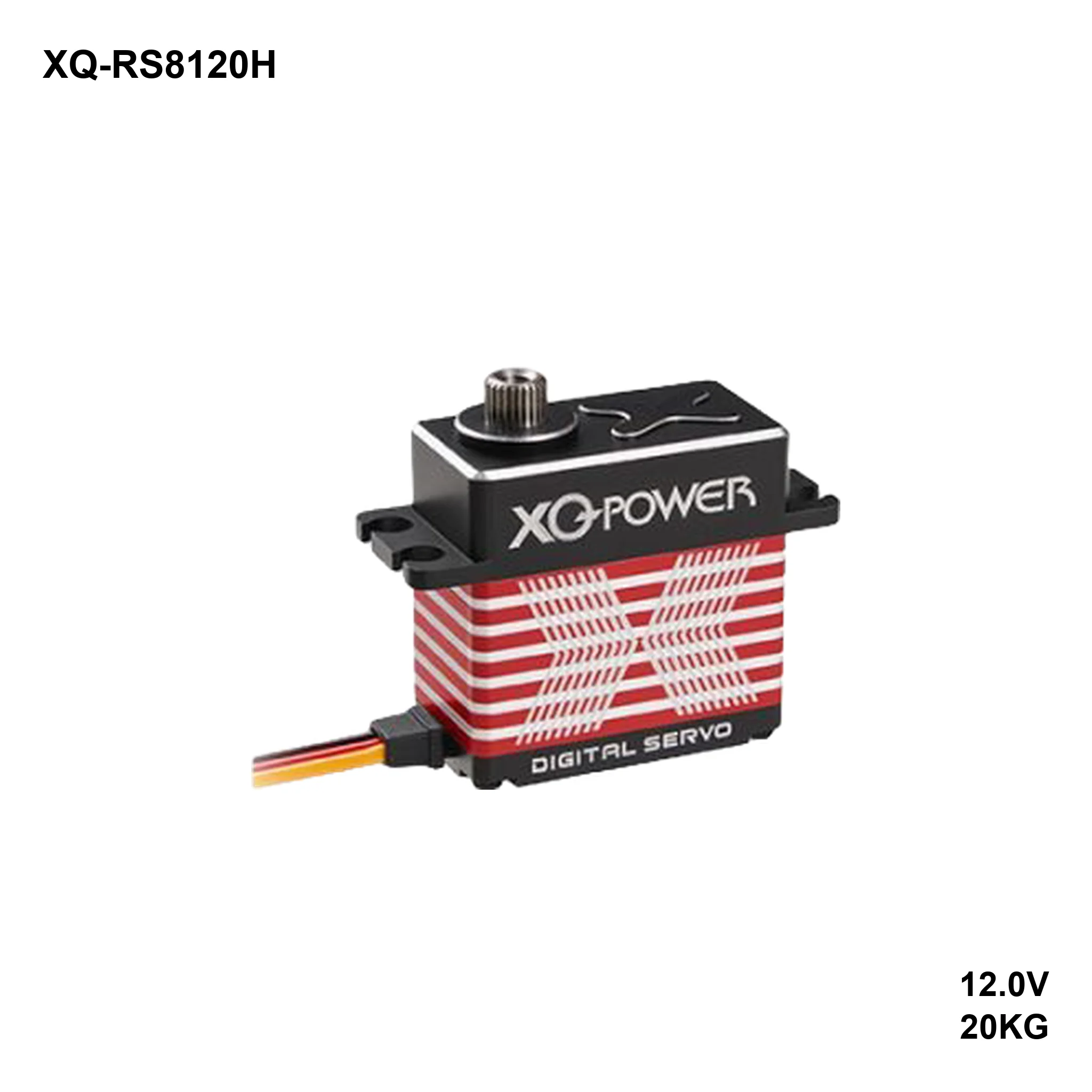
| 20KG·CM STALL | 0.030S/60° NO-LOAD | 12V RATED |
| 78G WEIGHT | StainlessGEARTRAIN | 360°TRAVELCustomizable |
Overview
The BLS8120H is a tail servo, and the spec sheet reads like one: a 510–1010 µs pulse window with 760 µs neutral rather than the usual 1000–2000 / 1500. That narrow window is what lets a tail gyro command fine corrections without the resolution loss of a full-range channel.
The case is the standard 20 × 40 × 38 mm aluminium block at 78 g, with a stainless steel geartrain on two ball bearings and a 25T-φ5.96 mm spline. Built-in motor is brushless, and the lead is 300 mm of 22 AWG.
This page covers the RS-485 build: the same mechanics, commanded over a differential serial bus instead of a PWM channel. It is the version to pick when several servos sit on one pair of wires or when the cable run is long enough that a single-ended signal would pick up noise.
Performance at each supply voltage
| Supply | No-load speed | Peak stall torque | Idle current | Stall current |
|---|---|---|---|---|
| 7.4 V | 0.050 s/60° (1200 °/s) | 12.5 kg·cm (1.23 N·m / 174 oz·in) | 320 mA | 2.8 A |
| 8.4 V | 0.044 s/60° (1364 °/s) | 15 kg·cm (1.47 N·m / 208 oz·in) | 370 mA | 3.5 A |
| 12 V | 0.030 s/60° (2000 °/s) | 20 kg·cm (1.96 N·m / 278 oz·in) | 440 mA | 4.0 A |
Control specification
| Item | Specification |
|---|---|
| Command signal | RS-485 |
| Amplifier | Digital controller |
| Dead band | 1 µs |
| Rotating direction | CCW (510–1010 µs) |
| Travel | 360°, customizable |
Mechanical specification
| Item | Specification | Item | Specification |
|---|---|---|---|
| Dimensions | 20 × 40 × 38 mm | Case material | Aluminium, CNC |
| Weight | 78 g | Geartrain | Stainless steel |
| Bearings | 2 × ball bearing | Motor | Brushless |
| Output spline | 25T-φ5.96 mm | Horn | Plastic, POM |
| Lead / connector | 300 mm, 22 AWG | Mechanical limit | 210° |
| Operating temperature | −15 °C to 65 °C | Storage temperature | −20 °C to 70 °C |
| Ingress protection | Splash resistant (customizable) | Travel | 360°, customizable |
What’s in the box
- 1 × XQ-RS8120H servo
- 1 × POM horn set
- 1 × mounting screw pack
Optional: metal horn, sold separately.
How to size it
The pulse window is not the standard one. 510–1010 µs with 760 µs neutral means a default 1000–2000 µs output will drive it to one end stop — set the radio or gyro to the narrow tail window before the first power-up.
Torque at 8.4 V is 15 kg·cm at 0.044 s/60°; on 12 V it is 20 kg·cm at 0.03 s/60°. Stall current stays at or under 4 A, so a 5 A BEC is enough for one, but not for a tail plus three swashplate servos on the same rail.
FAQ
Why is the pulse range 510–1010 µs?
It is a tail-servo window, not a standard channel. Set the gyro or radio to the narrow tail pulse range — feeding it 1000–2000 µs will drive the output against the mechanical limit.
What is the neutral position?
760 µs, i.e. the centre of the 510–1010 µs window. Do not assume 1500 µs.
Does the RS-485 build speak Modbus?
The inspection sheet lists RS-485 as the command signal and nothing more. Ask for the register map and the supported function codes before you write the controller code — do not assume a Modbus dialect.
How many servos can share the bus?
The limit is the address space and the current budget of the shared supply. Terminate the pair at both ends and keep the power pair separate from the signal pair.
Other interfaces
Downloads
- XQ-RS8120H inspection specification (PDF, 845 KB)
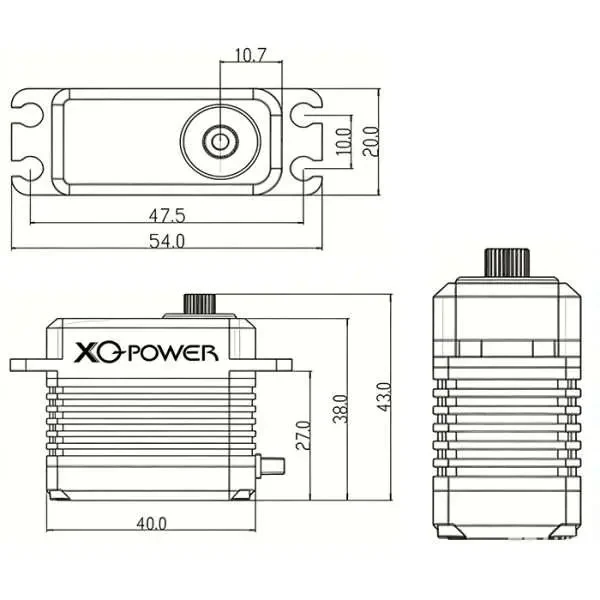
Torque, speed and current at each supply voltage, mechanical data, control specification, mounting dimensions. - 2D dimension drawing (image)
Mounting hole positions, case depth and overall height; the same drawing is inside the datasheet.