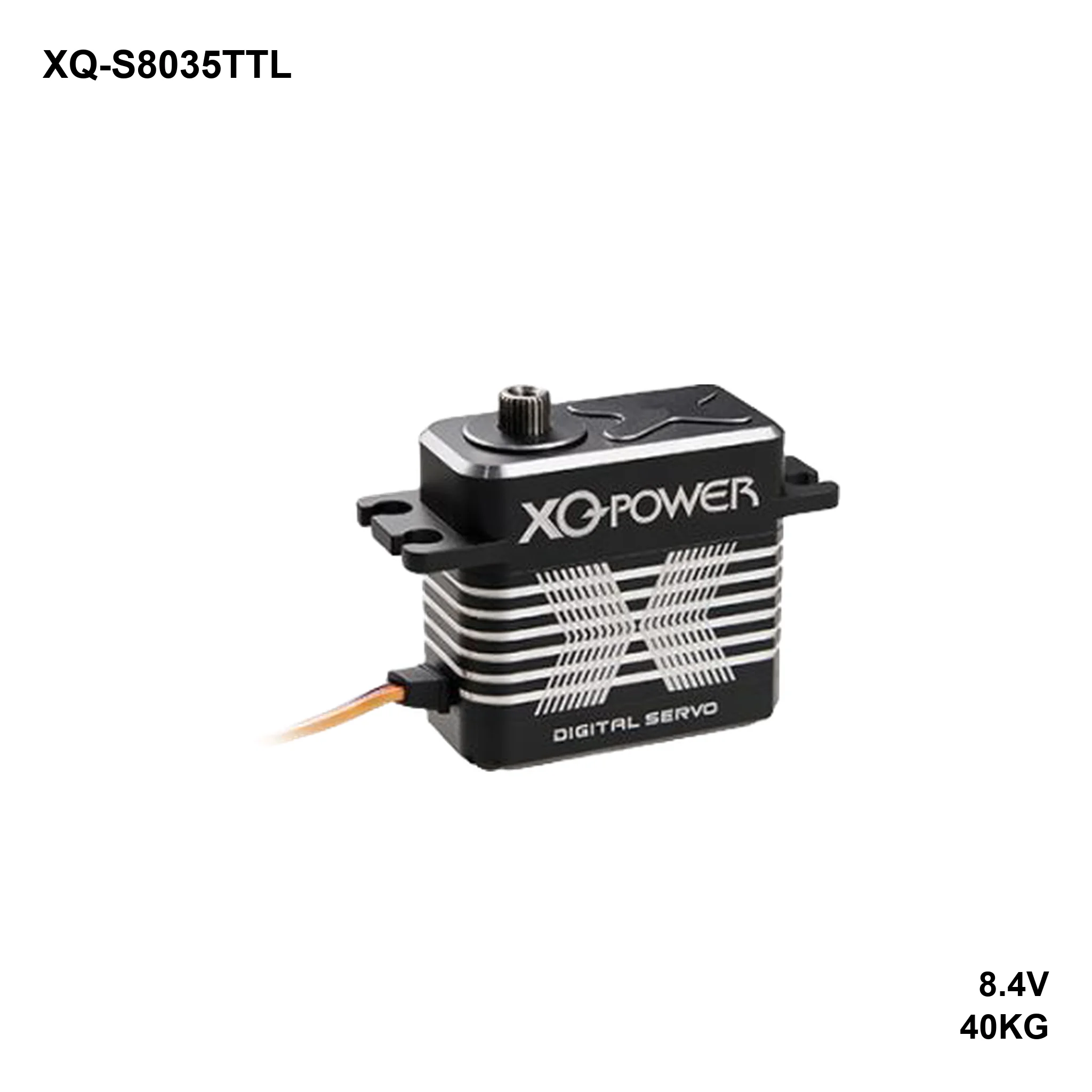
| 40KG·CM STALL | 0.088S/60° NO-LOAD | 8.4V RATED |
| 73G WEIGHT | StainlessGEARTRAIN | 360°TRAVELCustomizable |
Overview
The S8035TTL is the S8035D with the command layer replaced. The mechanics are identical — 40 kg·cm at 0.088 s/60°, 73 g, 20 × 40 × 38.4 mm, stainless geartrain on twin ball bearings, 25T spline — but instead of an 800–2200 µs pulse train it is addressed over a TTL serial bus.
The reason to pay for that is wiring. On a pulse-train build every axis needs its own signal wire back to the controller, and long runs pick up noise that shows up as jitter at the spline. A serial bus carries addressed commands on a shared pair, so a multi-axis assembly stays on one harness instead of a bundle.
Performance at each supply voltage
| Supply | No-load speed | Peak stall torque | Idle current | Stall current |
|---|---|---|---|---|
| 6.0 V | 0.131 s/60° (458 °/s) | 28 kg·cm (2.75 N·m / 389 oz·in) | 320 mA | 3.7 A |
| 7.4 V | 0.104 s/60° (577 °/s) | 34 kg·cm (3.34 N·m / 472 oz·in) | 370 mA | 4.5 A |
| 8.4 V | 0.088 s/60° (682 °/s) | 40 kg·cm (3.92 N·m / 555 oz·in) | 440 mA | 5.2 A |
Control specification
| Item | Specification |
|---|---|
| Command signal | TTL serial (addressed over a bus) |
| Amplifier | Digital controller |
| Dead band | 1 µs |
| Rotating direction | CCW (1000–2000 µs) |
| Travel | 360°, customizable |
Mechanical specification
| Item | Specification | Item | Specification |
|---|---|---|---|
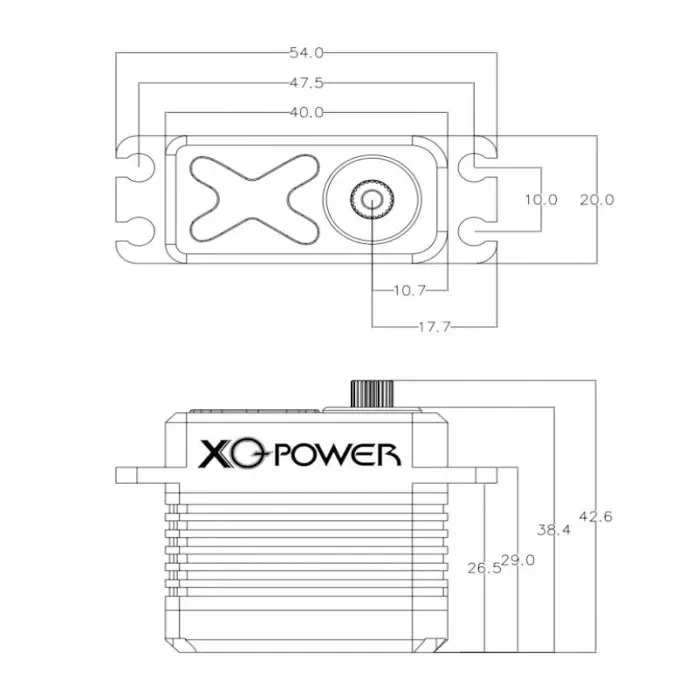
| Dimensions | 20 × 40 × 38.4 mm | Case material | CNC aluminium |
| Weight | 73 g | Geartrain | Stainless steel |
| Bearings | 2 × ball bearing | Motor | Coreless |
| Output spline | 25T / 5.94 mm | Horn in box | POM plastic |
| Lead | 300 mm | Travel limit | 360°, customizable |
| Operating temperature | −15 °C to 65 °C | Storage temperature | −20 °C to 70 °C |
| Ingress protection | Splash resistant (customizable) |
What’s in the box
- 1 × XQ-S8035TTL servo
- 1 × POM horn set
- 1 × mounting screw pack
Optional: metal horn, sold separately.
How to size it
Torque budget = load at the horn × horn length from spline centre × 1.5 safety factor.
Worked example: a 5.5 kg surface with its centre of pressure 32 mm from the spline centre needs 5.5 × 9.81 × 0.032 × 1.5 ≈ 2.59 N·m. The S8035TTL delivers 3.92 N·m at 8.4 V, about 52% headroom. On a bus-driven assembly that margin is worth keeping: if one node browns out under stall current, the whole bus can drop, so leave room rather than sizing to the exact load.
FAQ
What command set does it use?
TTL serial, and the frame format is fixed at the factory rather than configurable per unit — request the TTL command set before you write the firmware. Do not assume it is Modbus: the physical layer is not the protocol.
How many can I put on one bus?
The bus is multi-drop, so several servos share one pair, and the practical limit is your controller’s drive strength and the addressing space rather than the servo. Mixed models are fine — an S8035TTL, S8045TTL and S8050TTL can sit on the same bus and be addressed individually.
Can I drive it from a normal receiver?
No. A receiver outputs a pulse train; this build expects serial commands. If you have a PWM-only transmitter, take the XQ-S8035D instead — same servo, same torque, pulse input.
Can I run it directly from a 2S LiPo?
Yes. 8.4 V at full charge is the top rail in the inspection sheet and the rail the 40 kg·cm figure is measured at. The logic side still needs the supply your controller expects — check whether your bus master tolerates 8.4 V on the data pair before wiring it straight across.
Does it rotate continuously?
Travel is 360° when commanded over 1000–2000 µs, as a factory customization. On the serial build the same range is commanded over the bus. Continuous rotation is set at build time.
How much is 40 kg·cm in oz·in?
About 555 oz·in, or 3.92 N·m.
Downloads
- XQ-S8035TTL inspection specification (PDF, 787 KB)
Torque, speed and current at 6.0 / 7.4 / 8.4 V, mechanical data, control specification, mounting dimensions. - 2D dimension drawing (image)
Quick view of mounting hole positions and case depth; the same drawing is inside the datasheet.